




Like every other child, Jugal Bhatt didn’t always know that one day he would become a software engineer for Amazon, one of the most prestigious tech companies today.
In fact, his decision to study computer science was less a childhood dream and more a simple realisation that he lived in a world run by computers
“I would have either picked between mechanical engineering and computer science,” he says. “But today and even several years ago, everything we do is based on computers. I don’t remember a time when I had to deal with anything else. So, why not study how computers, or even phones, are made and how they work?”
So in 2019, fresh out of high school, Bhatt signed up to join Vellore Institute of Technology‘s four-year B.Tech in Computer Science programme.
He quickly realised where his interests truly lie — a move that would set him up to become a software engineer at Amazon US several years later.

Bhatt is a graduate of Vellore Institute of Technology. Source: Jugal Bhatt
While the B.Tech included both hardware and engineering-heavy components, it was the software side that drew him in. “Most of the projects and internships I did were all software-based systems,” he says.
Bhatt worked as a software engineer for one year and three months at a finance company.
But there was something in him that wanted more — pushing to look for master’s degrees in the US.
“The US has such a big impact on computer software,” Bhatt shares. “Much software was built in the US, especially AI, and pursuing a degree there seemed like a logical choice to be in that space and learn from the best.”
After applying to nine US universities, including Georgia Tech and UCLA, Bhatt chose the University of Illinois Urbana-Champaign (UIUC).
“UIUC had the same prestige for computer science as other top US universities, but it was a little cheaper, and I wanted to minimise my costs,” Bhatt explains.
In January 2024, he joined the Master of Computer Science programme at UIUC and graduated in May 2025.

Before joining Amazon, Bhatt was a founding software engineer at LiletLLM (YC W23), an open source Python SDK and Python FastAPI Server. Source: Jugal Bhatt
How he became a software engineer at Amazon: Create content on LinkedIn
Bhatt had finally attained what he wanted: a deeper understanding of computer science in the US.
But he found himself in a pickle.
“I was due to graduate in May 2025, but when December 2024 rolled by, I had no job offers,” Bhatt shares. “I had five months to get a job in the US before my Optional Practical Training visa gets activated.”
When he was looking for a job, Bhatt confided in his senior, who gave him simple advice: the more visible you are, the better your chances.
Don’t get him wrong, he was actively applying for jobs. It’s just that no one was picking up his application. So he started changing his strategy: creating content on LinkedIn.
He felt cringe at first. But Bhatt thought to himself what’s the worst that can happen? He’ll delete the posts if he couldn’t stand them anymore.
But what started as a cringey, calculated risk quickly turned into something when Bhatt began posting consistently about tech, AI, his projects, and what he was learning.
The response surprised him and today, Bhatt has over 26,000 followers.
“Once I started seeing results, that became the motivation to do more,” he says. “Trust me, when you put yourself out there, you will see results. And there will be one post that will completely change the trajectory of your career.”
He was offered a job as a founding software engineer at the startup LiteLLM, which develops an open-source Python SDK and a Python FastAPI Server.
He had commented on a couple of the LinkedIn posts written by the company founders and even contributed to their GitHub repository.
Then someone from the company reached out to ask whether he was interested in interviewing for a role.
Bhatt said yes, sat for the interview, and was later offered a full-time role after graduation.

Bhatt is a graduate of the University of Illinois Urbana-Champaign. Source: Jugal Bhatt
When the Amazon recruiter slipped into his DMs
One day, Bhatt received a message — one that answered many of his prayers.
“A recruiter from Amazon reached out to me because she saw my LinkedIn post,” he recalls.
The role, however, was a senior software engineer position. It’s typically reserved for candidates with three or more years of experience.
Rather than backing away, Bhatt chose honesty.
“I told her clearly that I only had about a year of experience and a master’s degree,” he shares. “I asked her how we could proceed with the experience I have.”
With the opportunity in the palm of his hand, Bhatt started sharing the openings he was eligible for at Amazon and asked the recruiter to reach out to the hiring managers internally.
That single follow-up changed everything. Soon after, he received an email confirming he was officially in the interview process to become a software engineer at Amazon US.
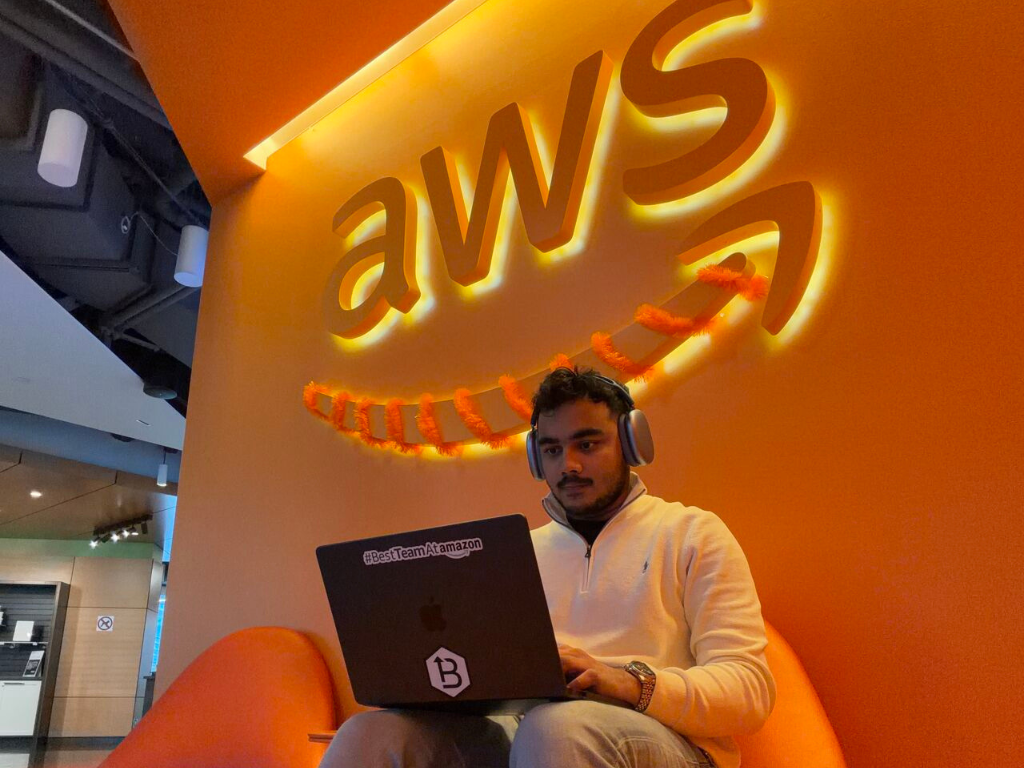
Before he was a software engineer at Amazon US, Bhatt studied computer science at a private university in Tamil Nadu. Source: Jugal Bhatt
How to ace the hardest interview for a top tech company
With a job interview secured, it was time for Bhatt get ready for it.
“Interviewing for big tech companies in the US is very different from interviews at startups or non-tech companies,” Bhatt explains.
While balancing his final semester, Bhatt prepared for the Amazon interview meticulously, identifying patterns and strategies that would later become advice he now shares with others.
“I prepared diligently, and two days after my final interview, I had my offer letter in hand,” he shares.
Bhatt conducted many mock interviews before the official one. He sought advice from friends who were already working with Amazon or other tech companies like Microsoft and Apple.
That wasn’t all. He asked his friends to spend one hour a week hosting mock interviews. That way, not only could they tell him what he was missing, but he could also self-reflect.
But Bhatt admits that technical skills are non-negotiables. For software engineering, Amazon US required candidates who are masters of data structures and algorithms.
From there, you’ll need to start building on other skills that will set you apart from other candidates.
“You need to show the hiring managers that you’re the person they want to hire,” Bhatt says. “You should participate in different projects that allow you to learn new things. Explain how the project helped you. Post all about it on your LinkedIn too, or even on X (formerly Twitter).”
It will set you apart from those who believe what they’ve learnt in school is enough.
“Creating case studies on companies can also help you boost your application and interview,” Bhatt explains.
“People love reading things like this as it showcases your skills and how you apply them to real-life problems. Showcase how you can fix the issue. There’s a chance the company might reach out to you to hire you.”