




Incarceration rates in the US are at an all-time high. There are approximately 1.8 million incarcerated people in the US alone, which is the largest total prison population in the world.
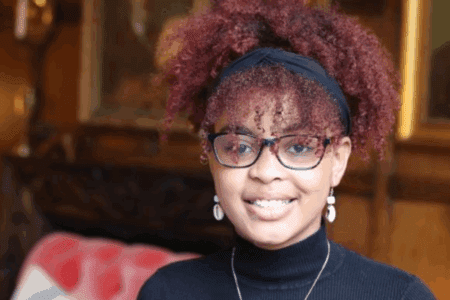
“In 2008, there were over 1.5 million people in prisons themselves, and we’re not counting jails, immigration detentions, juveniles, and probationers,” Jasmine Jordan, a PhD in Criminology student at the University of Cambridge, shares.
“We have more incarcerated people than other countries, including China and India, which all have over a billion citizens. We don’t even have a billion people in the US, and one in five of the world’s prisoners are in the US.”
Technically, researchers know how the US got there, but Jordan wants to know what effects and harm incarceration can cause, specifically towards a particular group — African Americans.

Jordan also completed a Master’s in Criminology from the University of Cambridge. Source: Jasmine Jordan
PhD in Criminology: Understanding the effects of incarceration in the US
In 1865, the 13th Amendment abolished slavery in the US. However, there was a grey area.
“Slavery ended with the 13th Amendment, but it’s not applied to someone who has been dually convicted of a crime,” Jordan shares.
Jordan admits that the truth is more complicated than that. The “Black Code”, also known as the Black Laws, was established. It was a racially segregationist and discriminatory set of US state laws that limited the freedom of African Americans but not of white Americans.
“It was filled with laws to punish people who were formerly enslaved,” Jordan explains. “So, it’s illegal for someone not to have a job. If you did not have a job, they’d arrest you and force you to work in a plantation that was not allowed to enslave you — but now you’ve been legally enslaved.”
Loitering became a crime, too.

Jordan is originally from Detroit, Michigan, US. Source: Jasmine Jordan
Now, how does this all relate to incarceration in the US? Well, history tends to follow.
A 100 years later, in the mid to late 90s, there was an exponential rise in incarcerated individuals.
Of these, nearly two million people, disproportionately Black, are living in prisons and jails instead of their communities. Compare this to the figures of the early 1970s, when this count was 360,000.
Today, 37% of people in prison or jail are Black.
“The thing is, there’s a higher number of White people being incarcerated; however, Black people are still disproportionately incarcerated,” Jordan explains.
So, as part of her PhD thesis, Jordan will be focusing on two to three sections:
- A quantitative project that will look into how mass incarceration can impact different political involvement
- Looking at how those with family or friends who have been incarcerated look at politics and how they participate in it
- A qualitative project in which she interviews Black women in Michigan who have a history of incarceration and are now involved in various activist and community engagement sectors. The pool of women who meet the criteria is small. Still, the goal is to understand shared themes in how they were involved in their communities before, during, and after incarceration, and how they rebuilt their political agency afterwards.

Before moving to the UK to further her studies, Jordan completed a BA in Political Science at Michigan State University. Source: Jasmine Jordan
We need to come up with an answer to incarceration in the US ASAP
Now, people may start posing this question: “Why should we care? We’re not living in the US, so why should we look into it?”
Well, it destroys lives.
“When you look at the US, the incarceration system is a sucker of resources from our society,” Jordan shares. “It drains people who are, and could be, useful to our society. It destroys their lives and exacerbates mental health problems. It causes problems that never existed before.”
Rehabilitation is key when it comes to working with incarcerated individuals. While there are programmes, they often fail.

Jordan’s PhD title is “The Symbiotic Harms of Incarceration: Political and Community Effects of the Incarceration of Black Women”. Source: Jasmine Jordan
More than 650,000 people are released from prison each year, according to the US Department of Justice; however, studies show that two-thirds are likely to return within three years.
“People return to prison, and may be locked up again for the rest of their lives,” Jordan comments. “They could have been rehabilitated, but the system destroys that chance.”
Jordan hopes that people outside of the US should take a general interest in how people go in and come out of prison, whether it be in their own country or in the US.”
Children of incarcerated parents often suffer, and it even leads to a decline in the child’s academics and health. When communities come into play, incarceration destabilises them and usually increases neighbourhood crime.
“Maybe there were more steps that we could have taken to stop an individual from entering the prison system,” she explains.
“By the time they’re placed in front of a judge, it may be too late. I believe that the solution to mass incarceration will not come from the courtroom or prison reform projects, but from re-education reform.”
Popular stories
10 best countries to study engineering that aren’t the UK, US, or Australia

9 countries with some form of social media ban for children

MSc at Audencia Business School: Make a difference with your difference

How to apply for university in the world’s most popular study abroad countries

You might like