

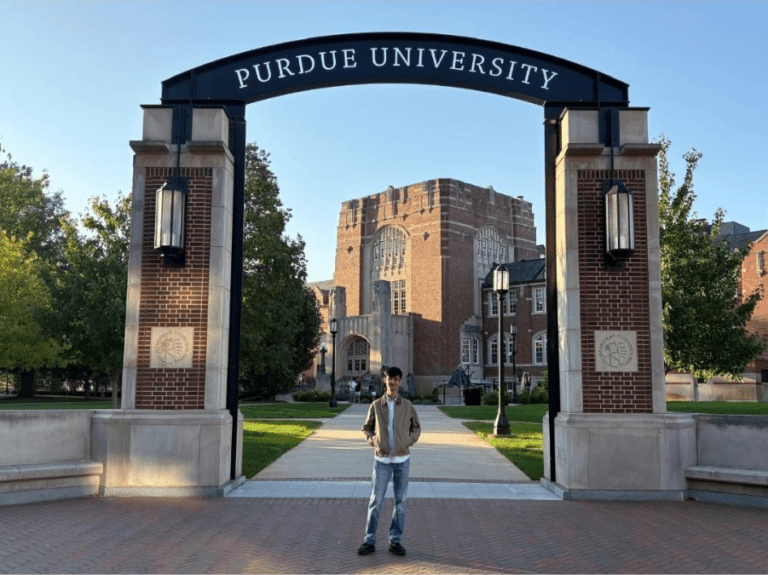


Looking at Amaan Tariq’s LinkedIn profile, you get a beautiful and linear outlook of his academic career. He started his tertiary education at Shiv Nadar University, where he studied biotechnology, before obtaining his master’s in King’s College London in August 2025. He’s now pursuing his PhD at Purdue University in Health and Kinesiology.
But zooming in, you’ll find that there were many bumps in the road, such as numerous PhD rejections. The journey has been much like a sine wave, Tariq quips.
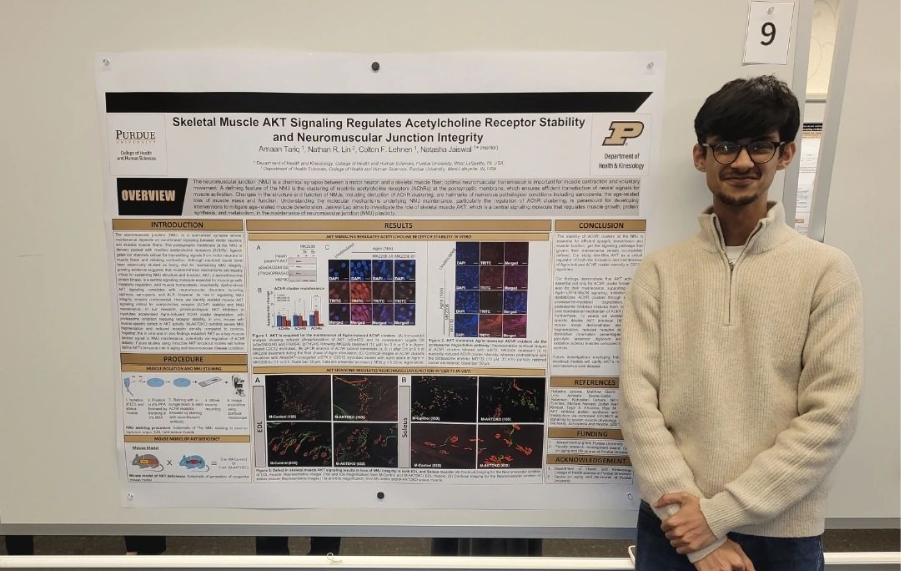
Tariq started his PhD programme in August 2025. Source: Amaan Tariq
Finding clarity in academia
Growing up in the small Indian town of Roorkee, Tariq was always immersed in an academic setting. His father was an academician and professor, teaching at a renowned institute in India (IIT Roorkee).
Instead of mechanical engineering like his father, Tariq chose to pursue biotechnology instead, encouraged by current events at the time of his undergraduate — the rise of COVID-19.
During the pandemic, Tariq began thinking about the sheer importance of things like vaccines and mRNA technologies. He recognised that in a country like India, especially before COVID, the biotech industry was not that huge due to limited awareness and funding. But he knew how crucial this research was, and how much potential the industry had.
So, he chose biotechnology. During the second year, he got an opportunity to be mentored by a professor at Indian Institute of Technology (IIT) Roorkee, a top school in India. There, Tariq gained hands-on aspects of research, which further developed his interest.
Then, in his third year, he was selected for a fully funded summer internship program at Johns Hopkins in Baltimore, Maryland. Only five students were selected across India.
“I remember when I was young, I watched a movie called Gifted Hands, which was about a surgeon who worked at Johns Hopkins,” Tariq recalls. “He did a surgery on conjoined twins who were conjoined by the skull. And it motivated me to be in a system where things like this happen. And that made me realise that India right now lacks funding for very ferocious and courageous kind of research.”
Heading to Johns Hopkins, Tariq witnessed how much funding and resources is available for research in biomedical sciences, and how seriously this research is being taken, and how deeply it impacts the society.
That internship at Johns Hopkins really exposed him to the wider possibilities abroad.
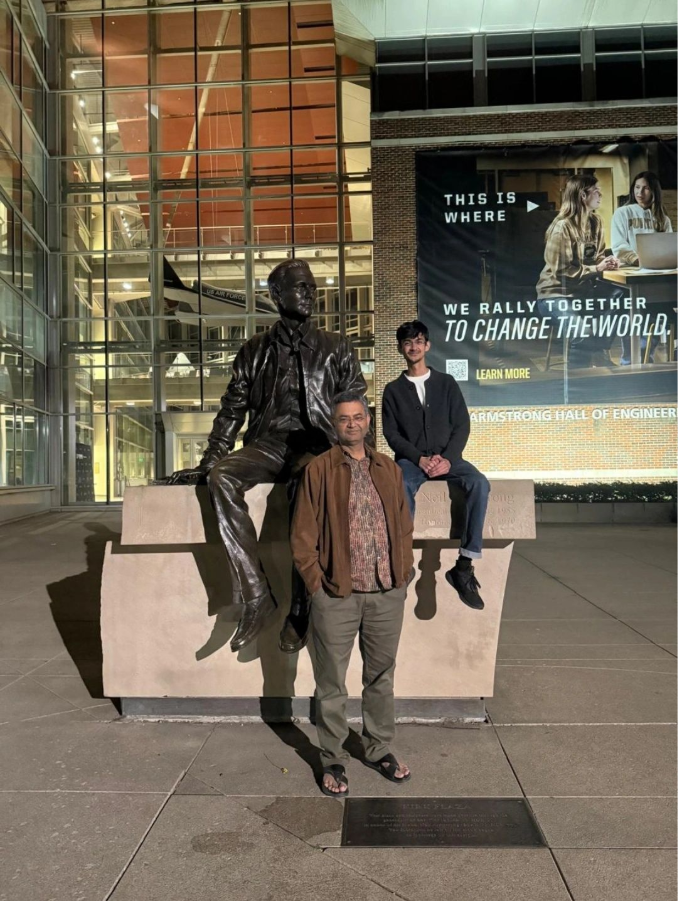
Tariq’s father teaches mechanical engineering. Source: Amaan Tariq
Skipping straight to the Phd?
Convinced about studying abroad, Tariq began applying for his postgraduate degree towards the end of his bachelor’s. Instead of starting with a master’s degree first, he jumped straight into applying for a PhD placement. Universities do not generally require a master’s degree before starting a PhD, but most students tend to go for a master’s first.
“I was blissfully unaware how difficult it would be,” he muses. “I got rejected from all the 10 places [I applied to], which was very difficult for me at that time particularly.”
With that outcome, Tariq ended up applying for a master’s programme. On the bright side, he already had his CV, statements, and recommenders prepared.
Thanks to that, he was accepted by the the University of Manchester, University of Leeds, Johns Hopkins University, and King’s College London.
He ended up choosing King’s College London over his next best option, Johns Hopkins, because it was a shorter programme. At King’s, he studied Biomedical and Molecular Sciences Research, developing his research capabilities.
But why do a PhD?
With his father being an academic, Tariq grew up understanding that a PhD is a journey where you are meant to struggle in the beginning.
“It’s not that you have 100% prepared to enter a PhD programme. It’s just that the competition is so high that most often the students who get selected are the ones who are mostly 95% prepared for it,” he says. “That does not mean that PhD is a journey which requires 100% of your preparedness. What it requires is perseverance.”
So, Tariq really believes in the power it wields, allowing people to build themselves, not just academically but in terms of character, and more.
With that clarity, and an overwhelming love for research, it was quite a disappointing ordeal for Tariq to overcome the rejections.
“I think that really helped me was, you have to accept how things are. This might be a philosophical idea more than a practical idea, but if you tried your best and if the outward situation is not in your hand, just do the best you can.”
He points out that he’s seen peers who might not have gotten the first thing that they desire, such as a PhD or a job. But they still ended up in a positive situation where they’re equally as happy — or maybe even happier.
“At the end of the day, you have to make meaning of what you have,” he says.
For him, he made meaning out of his master’s degree. In hindsight, Tariq is grateful for the longer route he took.
“There’s very good quote by Steve Jobs, that you can only connect the dots looking backwards. So, when now I look backward, I realised that I was actually not prepared, and that was the better thing that happened for me.”
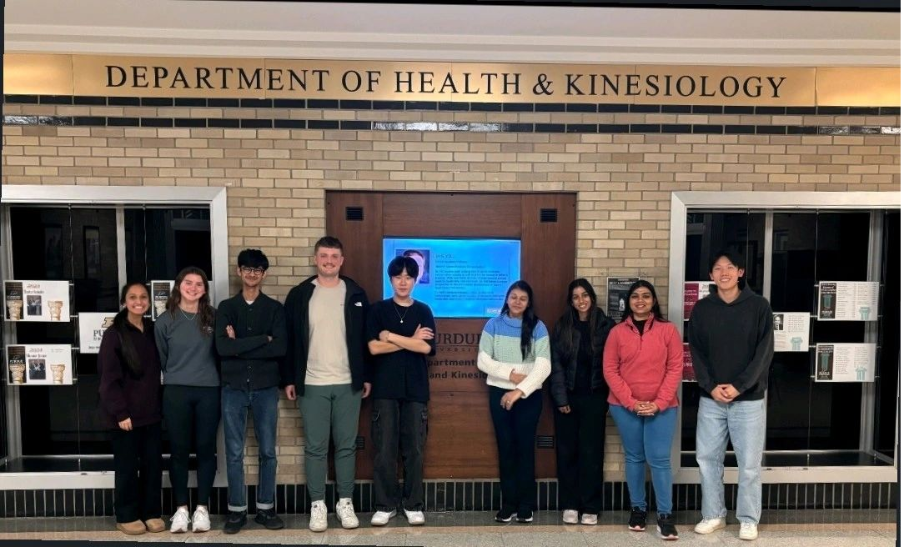
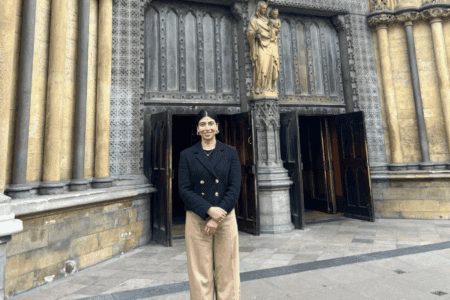
Tariq was at King’s College London from August 2024 to August 2025. Source: Amaan Tariq
Overcoming the PhD rejections
In December 2024, just a few months after starting his master’s, Tariq applied for four PhD programmes. Once again, he got rejected from all four.
“So now it has been 14 PhD programmes and I have not gotten a single acceptance,” he says. “It’s January 2025. I’m in turmoil. It’s winters. It’s cold. It’s London. It’s gloomy. So everything is affecting me, things are amplified.”
He quickly understood that merely writing applications wouldn’t help. So, he began to mailing his CV with his research interest to faculties and people whom he was interested to work with.
“Many people replied and many people were gracious enough to call me to meet them or to get on a call with me on Zoom,” he says “And one of the professors was from Purdue.”
Specifically, the professor was working in the Health and Kinesiology department – a departure from Tariq’s focus, but a place where he could apply provide new perspectives.
Applying for Purdue’s March deadline, Tariq finally got his first PhD acceptance. But the challenges weren’t over. At the time, the US visa cycle was frozen. For around 15 days straight, Tariq would check the visa portal every hour, until he finally secured a slot.
Officially a PhD candidate at Purdue, Tariq can now breathe easier. He finds the Indiana campus to be large and peaceful – perfect to do a PhD. Moreover, his department has been very supportive.
“Frankly, truthfully, when I started, I never imagined that I would end up here,” Tariq says.
While he always believed in his capabilities, he never envisioned himself doing this specific PhD programme at this specific university.
“It takes a lot of iterations and a lot of wrongdoings to get to the right path,” he concludes. “But yeah, I’m grateful.”
Popular stories
Internship, master’s, and PhD application tips from a Purdue scholar (who was rejected 14 times)

US$179,902 per year: 10 most competitive dentistry schools in the US and how much they cost

After 10+ PhD rejections, this Indian scholar is now a postgrad student at Purdue
9 most healing destinations to study abroad at