


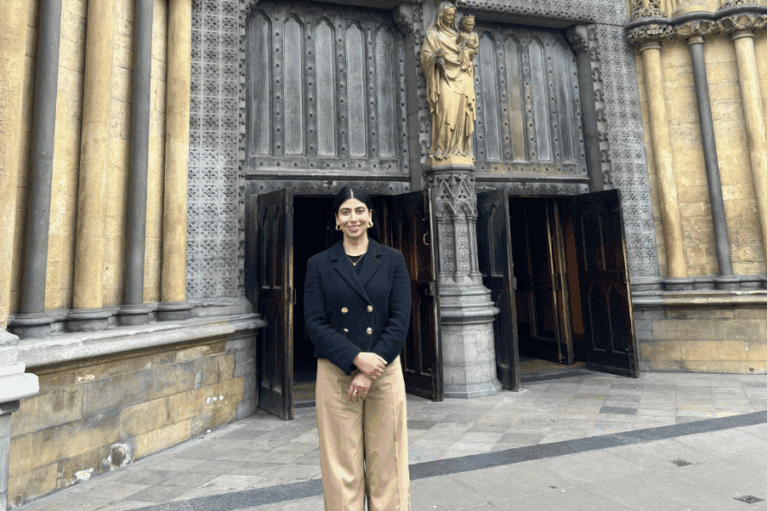


Ask anyone who’s shared a classroom with Aafreen Shah — be that colleagues, peers, or professors — and they would vouch for the fact that she is a “nerd,” as per her own words.
“I love being in spaces where I’m able to sort of critique, understand myself, my identity, and the world around me,” the Commonwealth Scholar says. “Even now, if I get a chance to go back to a classroom, I’d do that in a heartbeat.”
Proudly declaring to be “nerd” seems rare nowadays. Rarer still is someone who, at a time where many kids don’t even want to go to university, has obtained a second master’s degree.
Starting her higher education journey at St Stephen’s College in Delhi with an undergraduate degree in English Literature and Political Science, Shah’s first master’s degree is from Ashoka University.
Then, last year, she left India altogether, venturing to the UK as a Commonwealth Scholar. She was funded by the Foreign Commonwealth Development Office to pursue a second master’s degree in Education and International Development.
She studied this at UCL’s Institute of Education, a place that allowed her to focus on her passion: the education sector itself.
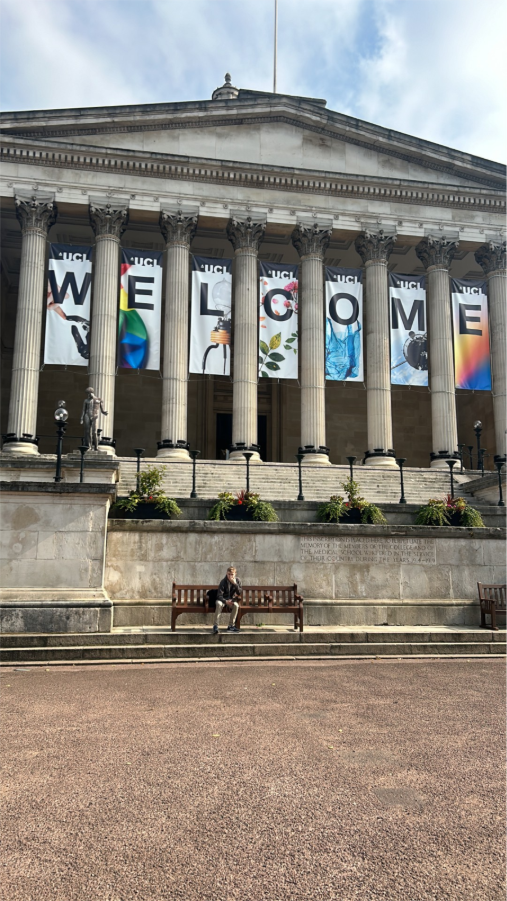
UCL, previously also known as University College London, is a leading, world-renowned public research university in central London. Source: Aafreen Shah
Growing an interest in education, through education
Shah wasn’t always set on developing a career in education, though. Like many young adults, she wasn’t sure what she wanted to study. One thing was certain, though — she loved social sciences.
“Not to sound pretentious, but I’m a deep-thinking individual. I think about all things mundane, so to speak,” she says.
That’s why she decided to pursue political science and literature for both her undergraduate degree as well as her first master’s degree.
It was whilst she was studying in Ashoka University that Shah began thinking about education as a space that she wanted to understand better. This interest was deepened when she worked as a visiting faculty at Ashoka for six months after obtaining her first master’s degree.
“I just decided to pause and think more about what it means to be in an education space,” she explains. The education and development space was simply what she felt truly passionate about.
“I think I’ve had my fair share of theoretical training, so to speak. But I wanted to think more in practice,” she says.
And with that mindset, she decided to pursue a Commonwealth Scholarship.
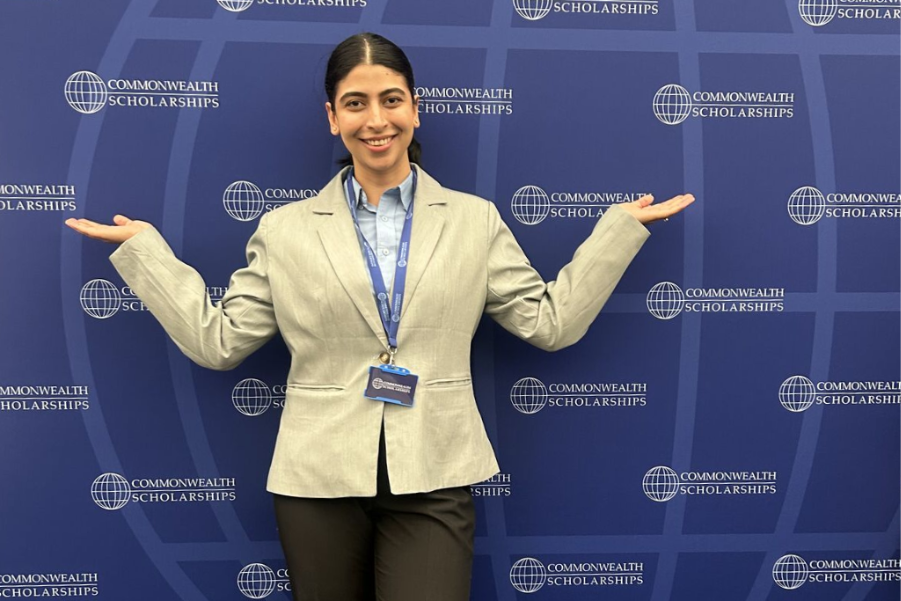
The Commonwealth Scholarship is a prestigious UK-funded program providing fully-funded postgraduate scholarships for talented students from Commonwealth countries to study in the UK. Source: Aafreen Shah
Why choose the Commonwealth Scholarship
Shah always knew that if she wanted to do another degree, she would want it to be fully funded.
“I completely believe that I shouldn’t be paying for my education and I definitely didn’t think it made sense to me at least — and I’m speaking from an independent point of view — to invest massive amounts of money,” she says.
This was especially because international students would have to pay double the tuition compared to home students in countries such as the UK.
As Shah developed her career, working as a visiting faculty member at Ashoka University, she began connecting with more students who had gone abroad. Through them, she began to understand the types of scholarships available and what each offered.
A planner through and through, Shah compiled all the information and created a master Excel sheet of all the scholarships available in the UK. She took note of the academic opportunities available at different universities, as well as what kind of faculty they offered, what networking opportunities were being promoted, and even what the location encompassed.
The reason for choosing the UK was that Shah wanted a global perspective, but didn’t want to invest another two years into a master’s, which would be the case in Europe or the United States.
“A master’s in the UK was a yearlong and I thought for me it made more sense because I wanted to focus with a micro lens into a country where I thought that I could sort of bag a scholarship,” she says.
As for choosing the Commonwealth Shared Scholarship, Shah was attracted by the comprehensive financial support.
“It would cover me fully in terms of my tuition fees, my stipend, my flight tickets, (and) my visa. I’m very grateful that there was no need for me to pay even a single penny, and it just made sense that I was investing my potential and time into something that I’m deeply passionate about,” she said.
Basically, it was fully funded. For a master’s as an international student at UCL, it would likely cost around 39,000 pound sterling (around US$52,533). That is quite the hefty sum! And don’t forget all the additional costs that would’ve been incurred from flight tickets.
Specifically, the main coverage of the scholarship includes:
- Approved tuition fees
- Economy class return airfare to/from the UK and visa costs
- A monthly payment to cover daily expenses
- Additional allowances for things such as warm clothing, study travel grant for research-related travel, thesis grant for PhD/Master’s research, and family/child allowance for eligible dependents
But it wasn’t just about the money. More than that, Shah appreciated the Commonwealth Scholarship Commission’s association with the Foreign Commonwealth Development Office, which connects her with the hundreds of scholars that it chooses every year. It also provided her the leadership platform she was hoping for.
“As a student, if I decide that I want to go for a degree abroad, I think the question that a student or an applicant should ask themselves is: What is their purpose or motivation behind it?”
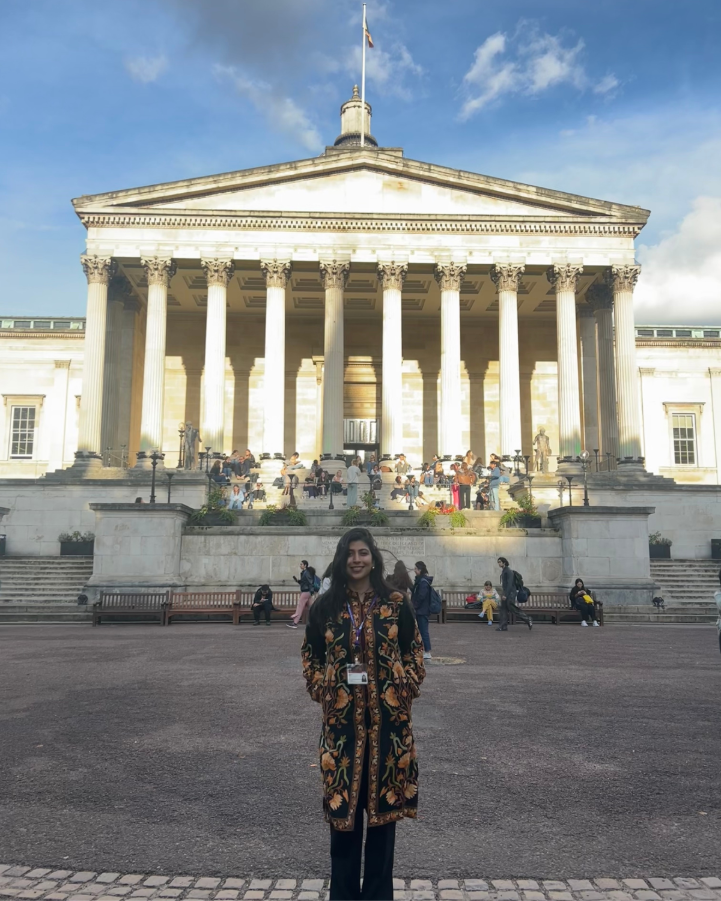
Shah got her MA in Education and International Development in September 2025. Source: Aafreen Shah
Her #1 tip for applying for a scholarship
If Shah had to boil it down to just one tip, it would be this: “Do not underestimate yourself. Even the smallest contribution in your classroom can help you. Envision your passion. What you want from your life is not just a seven-word sentence. Every experience counts.”
In other words, don’t sell yourself short, not to yourself nor to anyone else.
Another big part of her belief is being honest with yourself and what you want.
“I would just ask people to be old school, sit back, really think inward, think philosophically, think deeply. Why is it that you’re doing what you’re doing and why should it matter? Or why would it matter? Years from now on? And that would just be really my piece of advice,” she says.