



For years, there has been a common belief that a communications degree is “useless.”
For international students, the skepticism is louder, especially for those thinking about furthering their education in the field. Is a master’s in communications worth it? Why spend so much money on a “useless” degree abroad?
Riya Mittal is familiar with all those “concerns” and questions.
“I see where they’re coming from,” she says. “But I think people forget that the world runs on communications.”
Today, Mittal is a graduate of Georgetown University with an MA in Communications, Culture, and Technology (CCT), and her journey serves as a counterargument to the idea that a communications degree isn’t worth the investment.

Mittal is a BA in Media, Economics, and Political Science graduate from Christ University, Bangalore. Source: Riya Mittal
Meet Riya Mittal, from India to the US
Mittal had already spent six years working in marketing when her path shifted.
“I did my undergrad in India,” she explains. “I did a triple major in media, economics, and political studies. Then, I worked in marketing for a couple of years, during which time I developed my own product idea. That’s when I started looking for universities in the US.”
Coming from a family where studying in the US had been a long-time dream, she saw a master’s degree as both a personal milestone and a strategic move.
“I wanted to start my own business and see if I could develop this product in a university because I wanted to do my master’s as well,” Mittal shares.
So, she applied to New York University, Georgetown University, and the University of Southern California — and got into all three.
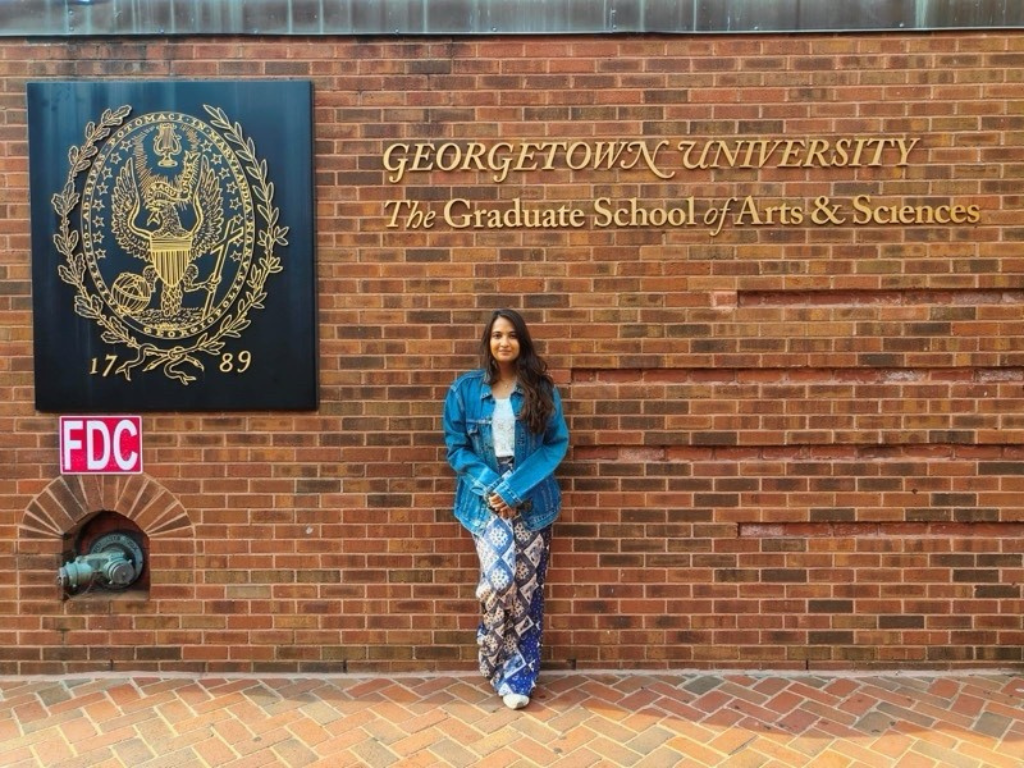
Mittal is currently a Marketing Coordinator at PAYRO, a human resources and finance company, in Virginia, US. Source: Riya Mittal
Why choose Georgetown University for a master’s in communication
Just as she was preparing to begin her studies, Mittal fell seriously ill and had to defer her admission by a year. In hindsight, it was a blessing.
“It gave me an entire year to research more about the university, about the difference between New York and DC,” she says.
What she discovered was that Georgetown’s entrepreneurial ecosystem was far stronger than she had anticipated.
“I was communicating with both universities for almost a year, trying to get resources on how to build your own business or product,” Mittal shares. “Georgetown’s very proactive and, of course, if you want to make a difference in the world, you have to be in DC. That’s where policies are, that’s where the difference starts.”
Another deciding factor was immigration practicality — something every international student must consider.
“As an international student, it’s essential to have a STEM major if you want a two-year STEM OPT,” she says. “Georgetown had a STEM programme. NYU and USC programmes are not.”
Ultimately, she chose Georgetown. To her, this would be the best master’s in communication to see how culture, community, and technology affect a product.

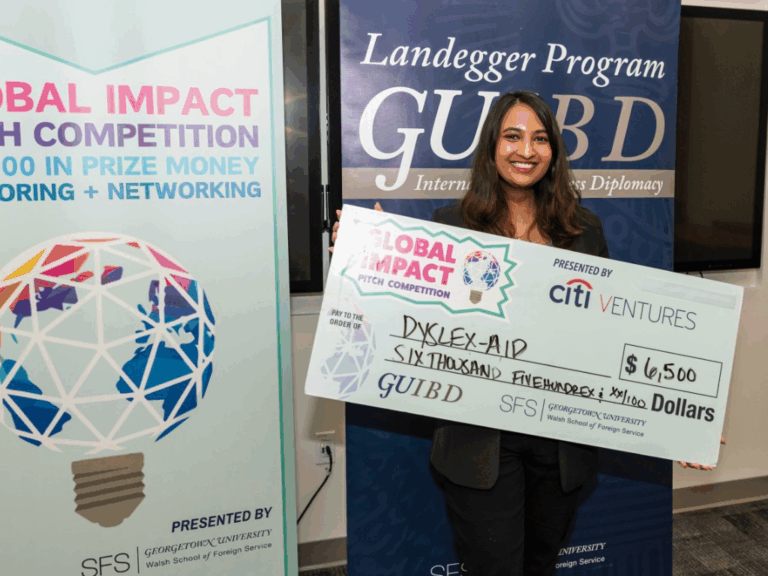
During her time at Georgetown University, Mittal founded Dyslex-Aid, an AI-powered reading intervention tool leveraging OpenAI to support students with dyslexia. Source: Riya Mittal
Is a communications degree “useless”?
Mittal acknowledges the reputation that communications degrees often carry.
“People say a degree in communication is useless, that it’s a waste of money,” she says. “I see where they’re coming from, but I think people forget that the world runs on communications.”
For her, the misunderstanding comes from “oversimplifying the discipline”.
People think communication is just talking, but it’s more than that. It’s about delivering a message to the right audience with the right tools.
Mittal points to one typical example: data.
“When we talk about data visualisation, that’s communications,” she says. “Coding is a form of communication. Interaction design is communication. There’s so much more to it than just PR and media.”
In her view, the real issue isn’t that a communication degree is useless. Instead, it’s a field that is constantly evolving, and students need to grow with it.

Before joining Georgetown University, Mittal was a Marketing Content Manager at Meolaa. Source: Riya Mittal
So, is a master’s in communications worth it? Especially from abroad?
For Mittal, the answer is yes — but not for the reasons people think.
What transformed her master’s in communications wasn’t only the technical training but the mindset shift.
Coming from India’s largely structured education system, US classrooms forced her to think in a different way.
“You’re so used to structure,” Mittal shares. “When the structure is challenged, you start coming up with innovative ideas. That about the US education system is amazing to me.”
She even cites a class with a professor of hers, Dr. Evan Barba, called “Frictions.” It challenges the idea that communications and technology must always be seamless.
“We learned how important it is for technology not to be user-friendly sometimes,” Mittal explains. “When you’re making a big transaction and a banking app asks, ‘Are you sure?’ — that friction is essential. It makes you think about what you’re doing.”
These insights shaped how she approaches product design, society, and the future.
Mittal’s time at Georgetown also introduced her to something she’d never experienced in India: robust learning support. For someone with dyslexia, this changed everything.
“The resources I had were mind-blowing,” she says. “I didn’t even think I could get those resources. It was the first time I felt supported in a classroom.”
So, is a master’s in communications worth it?
Yes.
“I don’t think an MA in Communications is useless,” Mittal says. “It’s amazing through and through. Communications is interdisciplinary. And the world needs to understand that.”
Popular stories
No part-time work, halal food everywhere: 7 things you should know before studying in Shanghai

Can you pay with cash in South Korea? Here’s what new students need to know

This young man faced health scares, layoffs, and rejection to reach Columbia

LDRs, visas, gender: Dating in 2026 as an international student