




Marketing has long evolved from posters on kiosks, jingles on the radio, and brochures in mailboxes — all traditional forms of outreach.
Just take a look at brands like Nike and Glossier. During Nike’s beginnings in 1964, co-founder Phil Knight had to literally drive himself to track meets and sell shoes out of the trunk of his car, developing relationships with athletes and coaches. When Glossier launched in 2014, it was after years of founder Emily Weiss running a blog called “Into The Gloss” online, using audiences as market research to design products that directly addressed their needs.
Today, both brands have built on their foundations by adopting the practices of a digital-first economy. Marketing strategies are no longer based solely on intuition. Data and analytics equip brands with the quantifiable evidence needed to inform their marketing strategies, with tools in automation and AI improving ad efficiency. Social media has opened new pathways for brands to interact with their customers, using tailored and/or story-focused messaging.
There is a downside to the rapid digitalisation, however. A survey found that marketing teams are facing the largest skill gap in data and analytics, and the demand for such professionals will only continue to grow from here. The US Bureau of Labour Statistics projects that market analyst jobs will increase by 7% from 2024 to 2034, which is much faster than that of other occupations. The top hiring industries are e-commerce, digital marketing agencies, healthcare, and tech, as their business growth relies heavily on data-driven decision-making.

Indiana University’s Kelley School of Business has positioned itself to meet the evolving needs of professionals and organisations. Source: Indiana University
To ensure the future of business are in skilled hands, Indiana University Bloomington’s (IU) Kelley School of Business has designed several 100% online Master of Science (MS) degrees in topic areas valued by employers. These programmes are asynchronous, where you learn at your own pace, and already cover fields like Finance, Business Analytics, IT Management, and Healthcare Management. February 2026 marks the launch of a new programme, designed to bridge the digital marketing skills gap in today’s industry: the MS in Marketing.
“The programme is built on the Kelley School’s strong reputation for academic excellence and is designed to be highly specialised and streamlined, with opportunities for students to apply theoretical concepts to real-world marketing challenges,” says Rom Schrift, the Arthur M. Weimer Associate Professor of Marketing.
What does an online MS in Marketing entail?
At a total tuition of US$25,500, the MS in Marketing is an offering with a great return on investment. Curriculum is both holistic and efficient. In only 30 credits (10 courses), you will earn your degree and develop a future-proof skillset that comprises the latest marketing concepts, tools, and strategies. Working professionals are set to benefit the most — you’ll get to apply the concepts learned immediately and with depth to your role.
This is because the MS focuses on analytics without sacrificing the “art” of marketing. “We teach students how to collect, analyse, and interpret marketing data using various tools and techniques,” says Schrift. “We also emphasise the importance of storytelling with data, so that marketers can effectively communicate insights to stakeholders and drive business decisions.”
Schrift’s main area of expertise and research is consumer behaviour, focusing on judgment and decision making. He brings more than 15 years of experience in developing, teaching, leading special workshops, and applying the systematic approach to creativity at different universities, businesses, and organisations around the world to his current role as chairperson of Kelley’s marketing graduate degrees.
His experience, in industry and academia, is telling of the depth of thought put into the programme’s design. “By emphasising marketing analytics, our programme prepares students to succeed in a rapidly changing marketing landscape, where data-driven decision-making is no longer a nice-to-have, but a must-have,” he says.
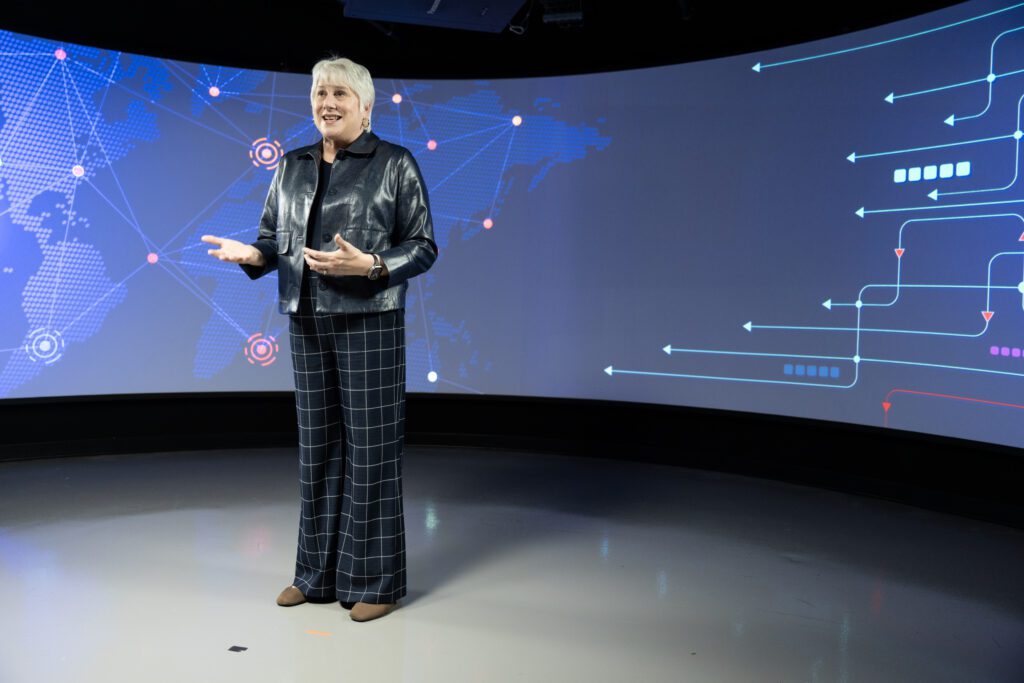
The Kelley School’s faculty members are committed to providing comprehensive support for online students. Source: Indiana University
After completing the 10 courses, you’ll have gained technical skills to develop a marketing dashboard to track key performance indicators (KPIs), measure campaign effectiveness, use predictive analysis to forecast sales and plan budgets, and so much more. You’ll learn to bring creativity and empathy to your practice through mastering brand management, marketing strategy, consumer behaviour, and more too.
Despite being a fully online programme, the MS in Marketing is enriched by real-world applications. You could be using analytics to develop buyer personas and targeted messaging, measure a campaign’s financial impact or calculate the return-on-investment. Community and learning support are set to be as if you are on campus as there is a dedicated team to troubleshoot any issues.
“Our expert faculty and staff make regular check-ins with students to ensure they’re on track, address any concerns, and provide feedback on their progress,” says Schrift. Every other week, optional live discussion sessions are held to gauge comprehension on the topics covered. “We also encourage community building through webinars and social media groups that provide opportunities for students to connect with their peers, alumni, and industry professionals,” he says.
Check out the Kelley School’s online MS in Marketing programme today.
Follow the Kelley School of Business on Facebook, X, LinkedIn, Instagram, and YouTube.