




The world is changing rapidly and McMaster University in Ontario, Canada has an Economics undergraduate programme that leads this moment. Recognising that economics is a fascinating field of study that leads to an extensive range of careers, its lineup of degree options puts learners first. Your ambitions come first.
If you’re a high achiever who wants to move quickly into advanced, graduate-level work, there’s the Combined BA Specialist and MA in Economics Option. Prefer a fast-tracked, efficient pathway to a successful career in economics and related fields? Choose the Accelerated Honours Economics option.
Here’s how the first option – the newly launched dual BA/MA option — works. You can choose an accelerated timeline to earn both the Honours Economics (Specialist) BA and the MA in Economics in as little as four years, instead of the usual five or six years. However, this accelerated route is not compulsory. Depending on your preferences, you can complete the Honours BA (Specialist) in three or four years before spending an additional year completing the MA. It’s a direct and streamlined route into the MA – without a separate application or application fee. More importantly, you’ll receive a conditional offer of admission to the MA in Economics that’ll give you clarity and confidence about your next step early on, especially with the department’s tailored guidance and support. Planning, support, and progress to master’s study – all three start early on this route.
For those looking to fast-track their academic journey, the Accelerated Honours option lets you complete your undergraduate degree sooner, creating an opportunity to progress to the MA in Economics earlier. Intensive and focused, this option is for those who thrive in fast-paced settings and want to acquire deep skills applicable across a range of industries, including finance, international trade and development, consulting, and government. McMaster reports that 82.6% of graduates are employed within six months, while 26% continue their studies with further education or graduate school.
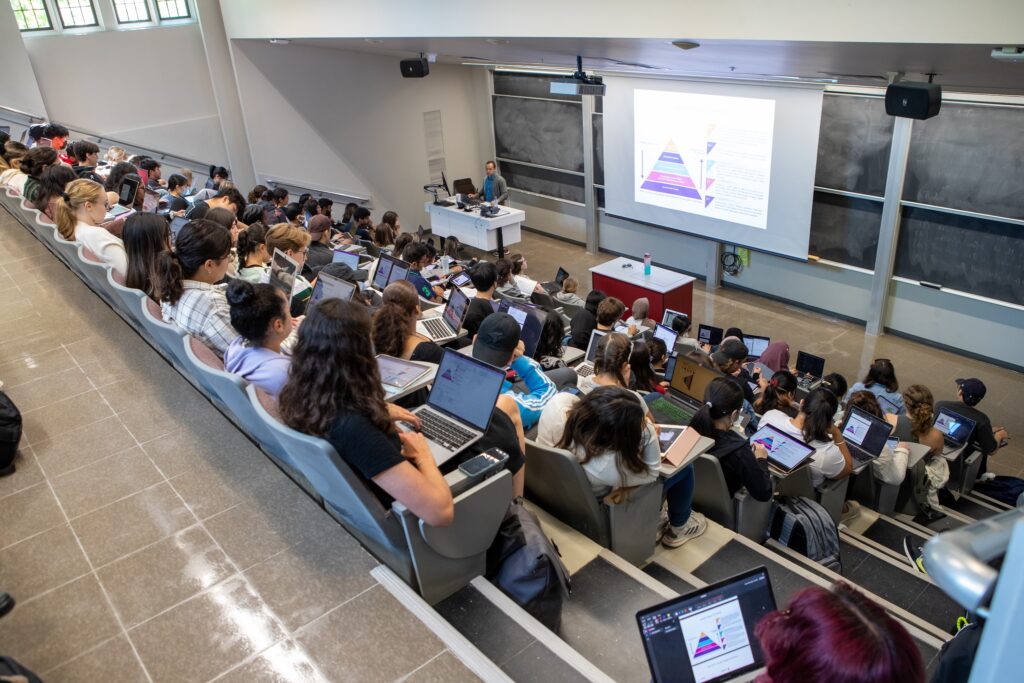
McMaster University is ranked 8th in Canada in the QS World University Rankings 2027. Source: McMaster University
Hands-on and work-integrated opportunities that connect learning to real-world contexts
Laraib Saleem grew in confidence and competence during her work placement at the Financial Services Regulatory Authority of Ontario. As a Research and Risk Analyst in the Regulatory Credentialing Oversight Unit, she got to see how the economic, analytical, and research skills she developed at McMaster translate into real-world decision-making.
Through the Honours Economics Co-op, students complete paid four-month work terms as part of their five-year Honours degree. Elective internships, on the other hand, can last four, eight, 12 or 16 months.
While coursework taught Saleem how to think critically about incentives, data, policy, and decision-making, this co-op let her apply those skills on financial services policy, regulatory research, data analysis, and cross-jurisdictional initiatives.
“One of the biggest things I’ve learned is how to take a broad or sometimes ambiguous problem, figure out what information is needed, analyse the evidence, and turn it into something useful for decision-makers,” says the fifth-year Honours Economics co-op student originally from Jeddah, Saudi Arabia. “I’ve also had opportunities to present my work, write briefing materials, collaborate with different teams and stakeholders, and work with large datasets.”
Research is another way McMaster students get to explore complex challenges. As one of Canada’s top research universities, McMaster brings together researchers studying society, behaviour, and the economy. For example, McMaster economists have examined how minimum-wage increases affect household labour supply, earnings, and time use, and how Canada’s Tax-Free Savings Accounts affect the savings and asset-location choices of families with children.
Their expertise also extends beyond academia, informing public conversations on some of today’s most pressing issues. McMaster faculty members have shared their insights on topics such as the lacklustre effectiveness of US tariff policy, how hybrid work boosts productivity, and the complexities of inflation and the cost of living.
Saleem came into the programme thinking such tangible problems would not be part of her curriculum – only to find out they very much are. Some of her favourite experiences here have involved solving real-world challenges through data, finance, policy, and human behaviour. She’s built models and worked with real data sets. As president of the McMaster Economics Society, she’s joined academic events, career panels, mentorship, case competitions, and socials.
And as part of McMaster’s team for the Bank of Canada Governor’s Challenge, she will be putting her entire degree to the test. Her team is analysing the Canadian economy and thinking about monetary policy using economic theory, current data, and research. It’s an experience that is teaching her the real value of a McMaster economics degree – not the memorising of models, but how to approach complicated questions, use coding, and economic modelling to work with real-world data, and make well-supported arguments from the evidence. “Those are skills I’ll carry into almost any career,” she says.
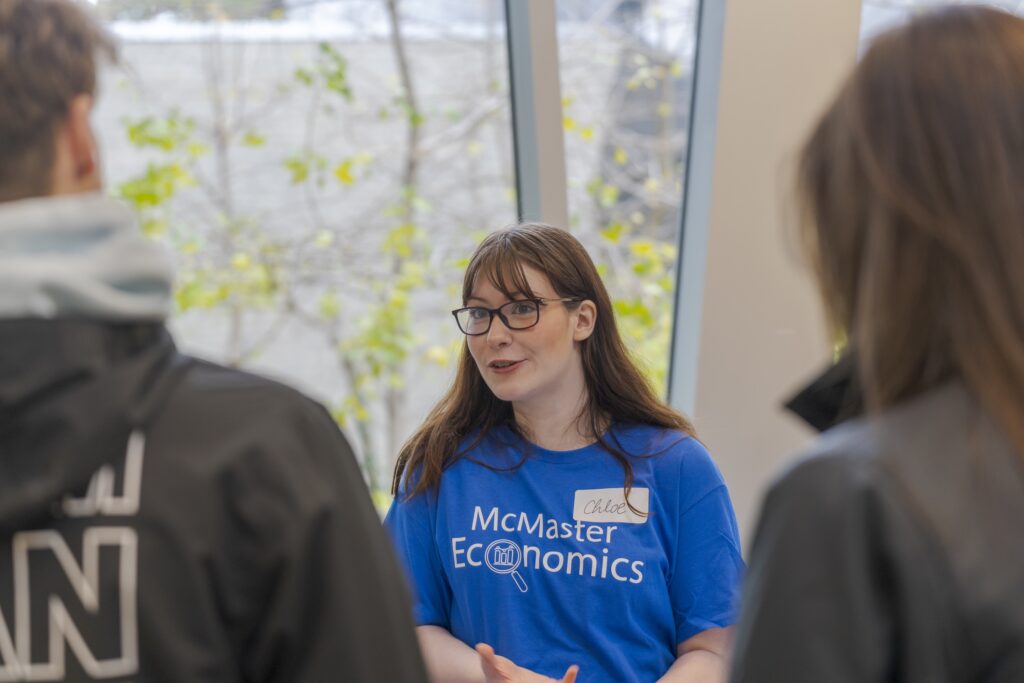
McMaster University economics graduates pursue successful careers in law, finance, politics, business, academia, and other fields. Source: McMaster University
Graduate ready for a wide range of careers
An economics degree is more versatile than a business degree. While a business degree often focuses on how organisations operate through areas such as marketing and management, economics looks at the forces behind decisions. You’ll learn how incentives shape behaviour, how public policy affects markets, and how people and resources interact. This gives you a toolkit for asking better questions, weighing trade-offs, and understanding complex issues.
Saleem discovered this breadth in knowledge and skills through her courses. Econometrics and economic data analysis taught her to test ideas rather than rely on assumptions. Financial Economics helped her understand investment decisions, while research-focused courses gave her the chance to evaluate published papers and conduct an empirical study.
Aryan Vaswani, a Class of 2024 Honours Economics graduate, credits McMaster for giving him a strong foundation in analytical and quantitative thinking to explore various areas within finance after graduation. “The programme gave me the opportunity to work with data, research different economic and financial topics, and develop skills that I’ve been able to carry into my internships and CFA studies,” he says.
Learn more about McMaster University’s Department of Economics, and chat with current students.
Follow McMaster University’s Department of Economics on Facebook, X, and Instagram