
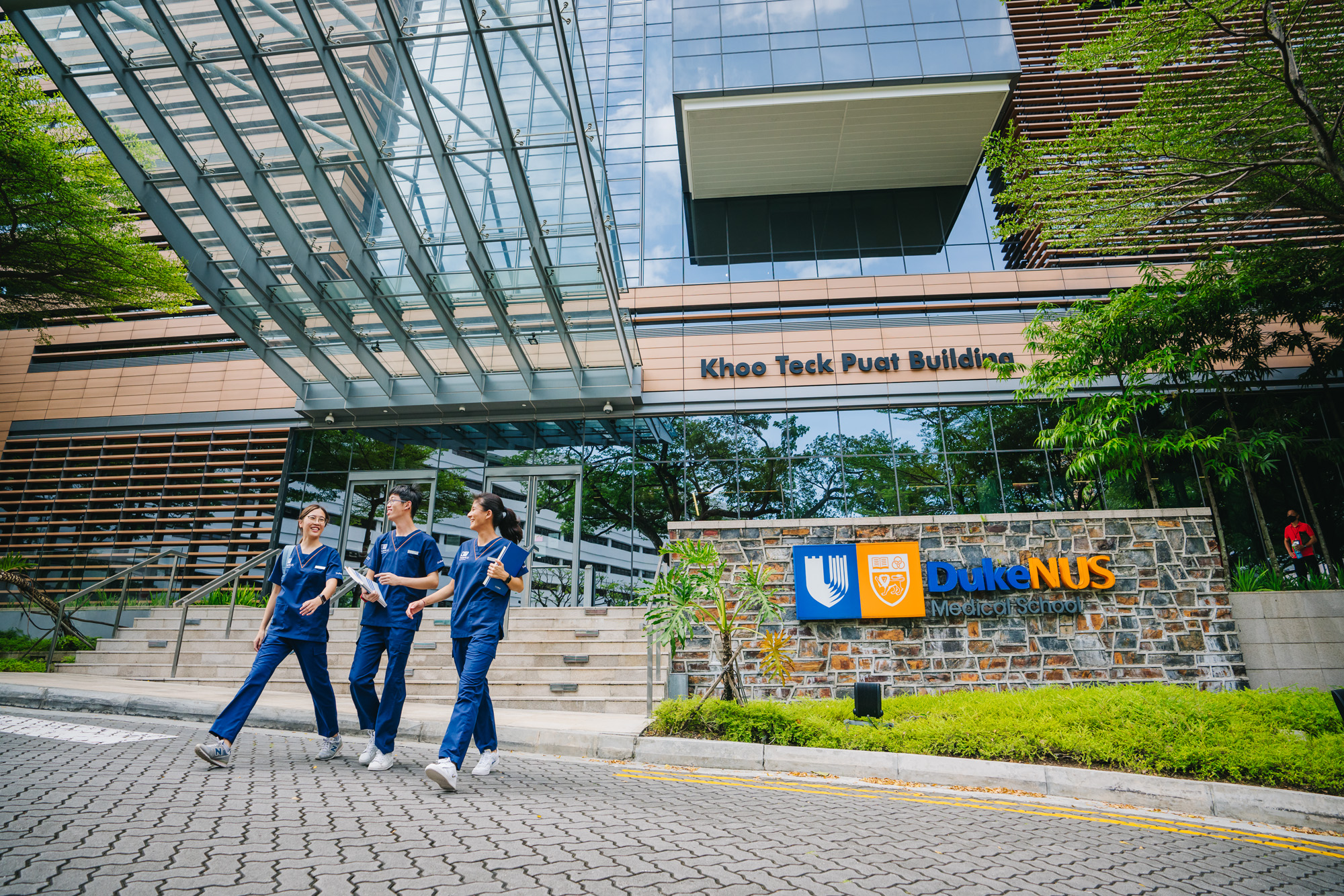


Dr. Katherine Nay Yaung didn’t follow the typical path of studying medicine straight out of school — and she’s among the many driven individuals at Duke-NUS, where diverse journeys into the profession are welcomed and valued.
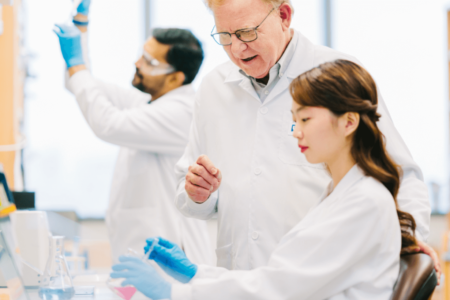
Her interest in medicine was first sparked in junior college, where she volunteered in hospital settings and discovered a deep appreciation for patient care. But when it came time to choose a university path, she gravitated toward biomedical science — drawn by a fascination with discovery and research. It wasn’t until she found the MD-PhD programme at Duke-NUS that she realised she didn’t have to choose between the lab and the clinic — she could do both.
“I did not want to decide between the joy of discovery and the fulfilment of patient care,” she says. “When I learned about the Doctor of Medicine (MD)-PhD Programme, it felt like a perfect fit, offering a way to translate scientific insight into real-world clinical impact and to contribute meaningfully to a healthcare system I believe in.”
Aspirations like hers are the norm at Duke-NUS. As well as maintaining a high bar for academic and professional readiness, the School stands apart in welcoming students from all academic and professional backgrounds. “Each person brings a unique perspective to clinical and other discussions,” says Nay Yaung. “This diversity pushes me to think more creatively and approach patient care more holistically.”
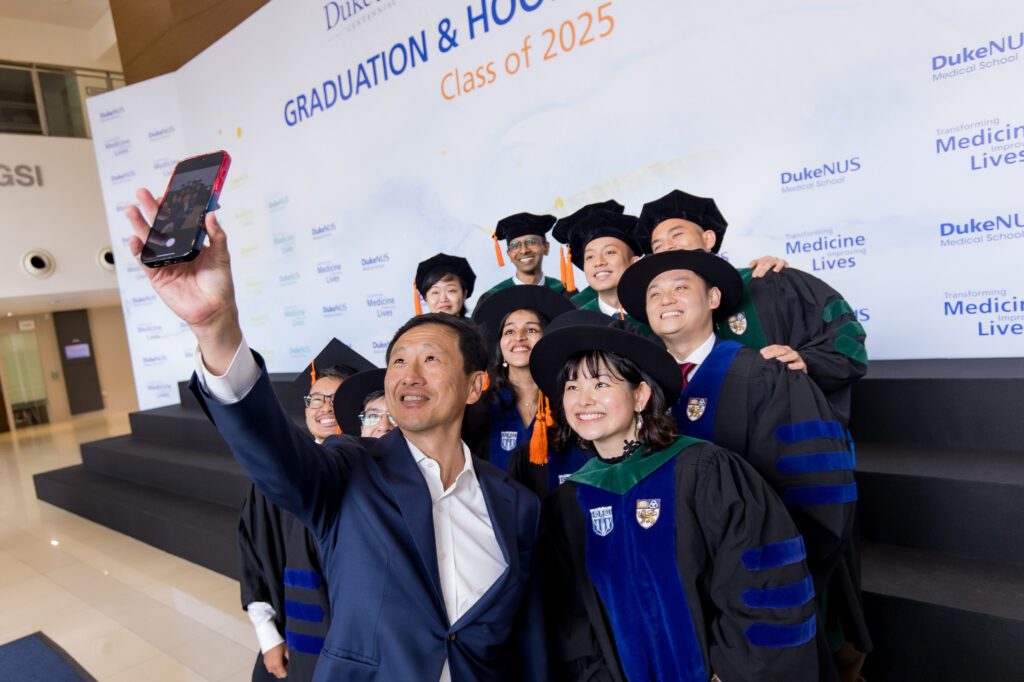
Dr. Katherine Nay Yaung (front row, right) and fellow Duke-NUS graduates take a selfie with Singapore’s Health Minister Ong Ye Kung at this year’s Graduation Ceremony. Source: Duke-NUS Medical School.
Different journeys, shared ambition
Nay Yaung is among the five MD-PhD graduates from Duke-NUS’ Class of 2025, which included another 67 MD graduates, and 27 PhD candidates—from the Integrated Biology and Medicine, Quantitative Biology and Medicine and Clinical and Translational Sciences programmes—as well as 22 Master’s graduates.
A testament to its mission of offering a distinct and alternative pathway to medicine for students from diverse backgrounds, 41 per cent of MD and MD-PhD graduates have transitioned mid-career from professions that include law, public relations, accounting and mental health peer support.
To Dr. Jedidiah Ryan Ng, the diversity of Duke-NUS’s student body brought a unique richness to his medical training. “There was usually an individual in my class that is better at something than I was,” he says. “This has included technical subjects like coding and artificial intelligence from friends who studied computer science, or specific subjects from others who gained a solid foundation through their own research projects or in undergrad.”
Like them, Ng’s journey to becoming a doctor didn’t start in a high school classroom. For him, it began in the back of an ambulance – during his National Service, where he served as an EMT instructor. “I really enjoyed applying what I had learn from high school biology to real life, and the potential to interact with and help people during some of their most difficult times,” he says.
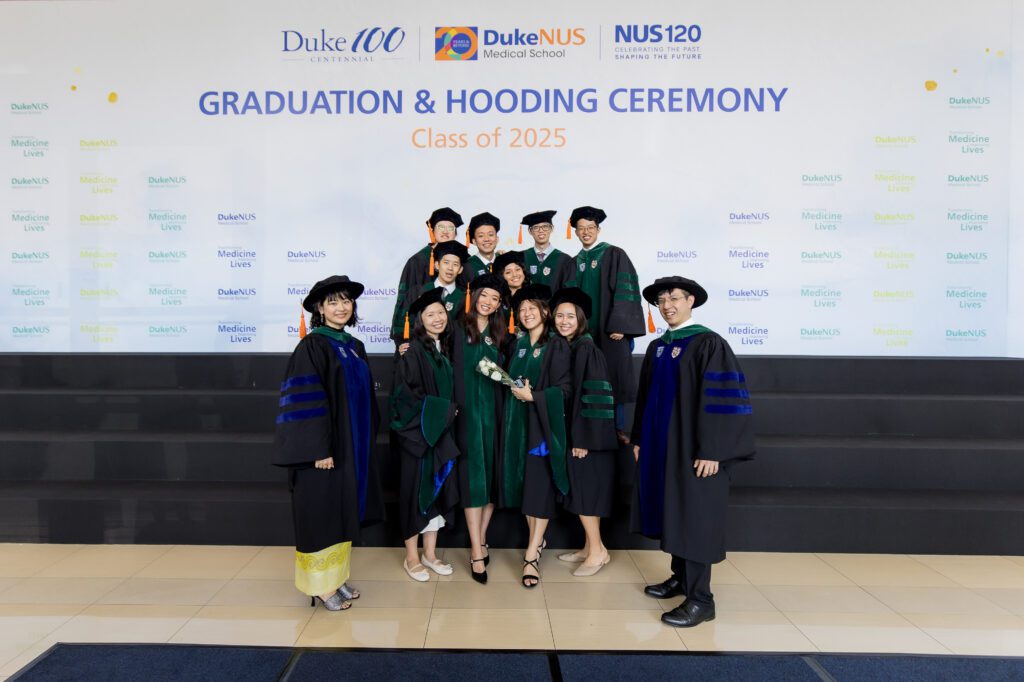
Dr. Jedidiah Ng (back row, right) celebrate with their peers at the 2025 Graduation Ceremony, which saw a record number of 121 graduates from the School. Source: Duke-NUS Medical School.
That initial spark would grow into a steady fire. After graduating from the University of Alberta with a degree in biological sciences, he came across the Doctor of Medicine (MD) Programme and saw it as an opportunity to serve, learn, and grow as part of Singapore’s medical community.
A former national-level swimmer, he brought discipline and drive to his medical training — but that didn’t make the transition any less intense. Early on, he found himself stretched by the volume and breadth of content. “Clinical learning is very different,” he says. “But I eventually adapted.”
As he settled in, Ng began to master the balance between clinical essentials with critical thinking — a skill that proved invaluable during rotations, where real-time decision-making had direct patient impact. His third-year scholarly project in clinical cardiology built on this foundation, as he navigated the demands of hospital work with research.
For Ng, perseverance was made easier by the people around him. “The faculty constantly hold themselves and us to a high standard,” says Ng. “This has trained me to be intentional while practising medicine.”
Learning alongside the giants of science
Learning at Duke-NUS means being mentored by experts whose work — from fighting cancer to investigating infectious diseases, from advancing science in fields like metabolism and neuroscience to shaping health policies that support healthy ageing— is transforming the field. For Nay Yaung, this provided her with the opportunity to work under the mentorship of renowned immunologist Professor Salvatore Albani on her thesis. The research focused on systemic lupus erythematosus, where she applied high-dimensional immune profiling and machine learning to better stratify patient subtypes.
“Coming from a more biology-focused background, I had to rapidly up-skill on areas of data analysis and experimental techniques,” she says. “I learnt a lot from these challenges, and I was reminded of why I chose the clinician-scientist path: to bridge the gap between complex biology and patient care.”
The opportunities for collaboration and growth at Duke-NUS extend beyond the classroom. Its unique positioning — drawing from the global insight from Duke, a strong national base from NUS and clinical excellence of SingHealth, — gives students rare access to work related to interdisciplinary projects, clinical trials, and translational research that directly impact healthcare in Singapore and beyond.
It’s quite the ecosystem – one Nay Yaung is proud to be part of.
“I’ve worked on interdisciplinary projects involving clinicians, immunologists, and data scientists. Presenting our work at both local and international conferences – including winning prizes at research symposiums – has opened doors to collaborations and critical feedback,” she shares. “These opportunities made me feel part of something larger: a system actively shaping the future of medicine and science.”
Follow Duke-NUS Medical School on Facebook, Twitter and YouTube