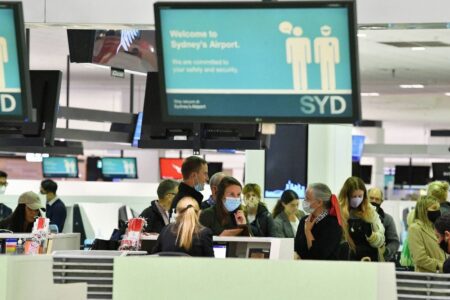


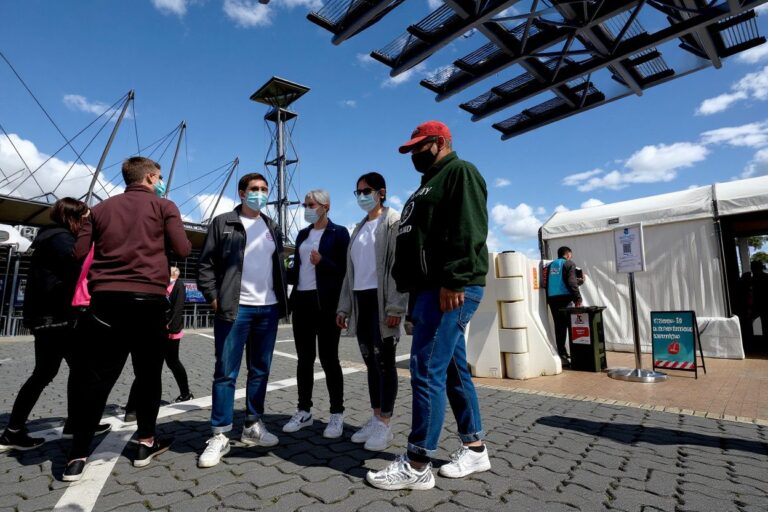


International students are crucial to policies on Australia immigration post-pandemic to ensure a steady supply of skilled and seasonal labour. The hard borders erected to keep COVID-19 have, however, plunged the migrant labour force it depends on into “a great crevasse” in 2020 after a boom from the mid-2000s.
“Over the last 10 years or so, we’ve been adding 200,000 to 250,000 migrants per year. So we go [from this] to minus 94,000 in the 2021 financial year,” says renowned demographer and columnist Bernard Salt. “So you can see the swing that’s taking place … it’s like falling into a great crevasse.”
Salt was presenting in the plenary session “The skills shortage: how international education can lead Australis’s recovery” at the Australian International Education Conference 2021.
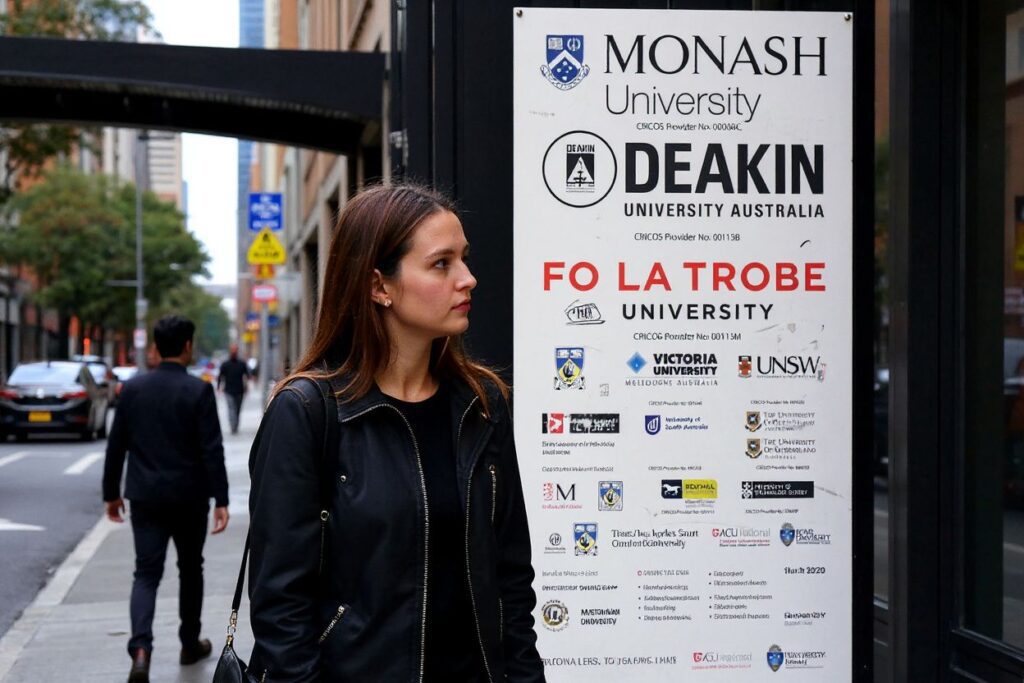 People walk past signage for Australian universities in Melbourne’s central business district. Source: William West/AFP
There were 7.7 million migrants in Australia in 2020, the majority of which come from the UK, India, China, New Zealand, the Philippines, Vietnam, South Africa, Italy, Malaysia, Sri Lanka, Nepal and South Korea.
“That’s about 30% — the great immigrant nation [of the US] isn’t anywhere 30% — it is 15%. Even if you add another five points for illegals, it’s 20%,” says Salt. “We are an outlier. We are an extraordinarily multicultural nation, quite used to large numbers of people coming in and contributing to the Australian lifestyle.”
How must the #intled sector respond & adapt to successfully help our nation rebuild?
Join @bernard Salt in our upcoming #aiecconnect webinar. Register Now! #aiecconnect https://t.co/TAXcJu98x9 LIMITED CAPACITY! @JChapmanTAFE pic.twitter.com/rmWY0uHQps— AIEC2021 (@AIEC) October 9, 2020
Australia immigration post-pandemic: Sunny days ahead
In the 2020s and the 30 years that follow, Australia’s baby boomers are leaving the workforce, a trend that started from 2011 onwards. “We kind of already knew that, but if in 2020-21, you stop overseas immigration and students coming into Australia, you would exacerbate the baby bust, which is where we are at the moment.”
“This was always in the cards. We’re always going to have to invest in skilling Australia — that’s why we lifted the levels of immigration. That’s why we’ve supported international students to offset the impact of the baby bust. All the pandemic has done has been to accentuate that so we lift that, drive it, and recover from it.”
Salt predicts this recovery of Australia immigration post-pandemic will begin in 2022. Past trends show similar big dips in the number of international students, for example, when the Australian dollar was at a high value.
“My point here is when you look back in time, it’s painful at the time but there is an underlying market for what Australia has to offer and we do actually recover from that, which is positive,” Salt says.
Popular stories
Budget pressures in 2026: The most affordable pathway options as tuition and living costs rise

Why we’re low‑key obsessed with where the ‘Boyfriend on demand’ cast went to uni

Low GPA? Here are the global pathways that still get you into top universities

Icahn School of Medicine at Mount Sinai: Leading public health professionals to make change