


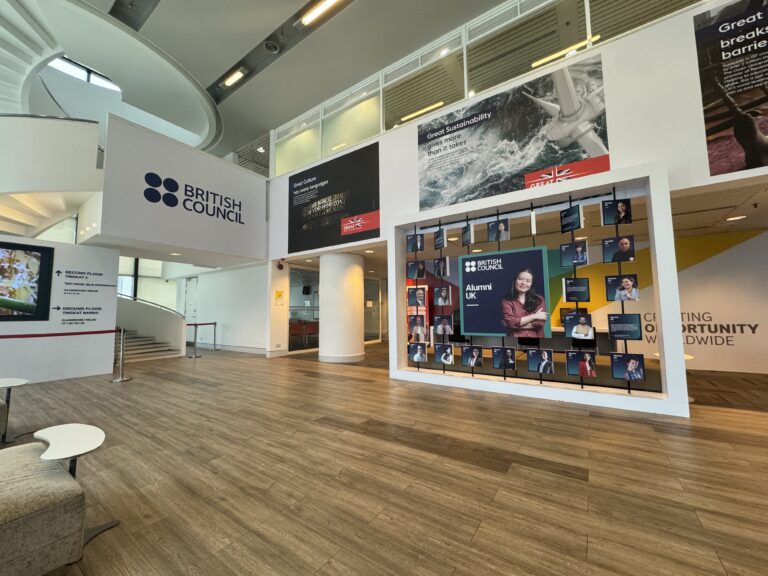


When you hear about the British Council, chances are you’d think about the place to take your IELTS examinations.
While that much might be true, in reality, the British Council reaches far beyond hosting language proficiency examinations. More than that, their goal is to build connections, understanding, and trust between the UK and other countries through arts and culture, education, and, yes indeed, the English language.
In Malaysia, the British Council has been active since 1948, making its local legacy older than the nation’s independence.
To understand the impact it has imparted on the Malaysian landscape, we spoke to Prabha Sundram, the Head of Education who has been at British Council for eight years.
Brokering deals and partnerships between Malaysia and the UK
“When I tell even family that I work at the British Council, they assume I either work in exams or that I teach,” Sundram says.
But really, the British Council’s work is broader than that. As a cultural relations organisation, what they do is build people-to-people relations between the UK and the countries where they work — such as in Malaysia.
They do this through education, the arts, and other cultural linkages.
One key task they have is facilitating partnerships, bringing institutions in the UK and Malaysia to work on areas of common interests. Higher education collaborations is one major part.
“We’re living in an almost borderless world at this moment, but what really attracts students to education is the fact that it can take them much further than where not having a degree, diploma, or education would get them to,” Sundram says.
And an education in the UK, for one, has been sought after for numerous reasons, including the strong and positive perception Malaysian have for a British education.
While the British Council doesn’t do hard-sell marketing for higher education in the UK, they support such agents in countries such as Malaysia with correct information about the UK.
They guide them on how to pitch their schools in the right way while encouraging them to look at strengthening their internationalisation strategies so that they can be more competitive and marketable to students abroad.
They also work to support students on the kind of information they should research, and also provide offer holders with pre-departure briefings before they head off to the UK.
According to Sundram, the British Council works very closely with the High Commission, so they would get firsthand — and accurate — information on changes immediately.
Connecting UK alumni with one another
Thanks to the longstanding relationship between the UK and Malaysia, the number of Malaysians who are alums of UK institutions is rather sizable.
There are plenty of students who have gone on to hold high-level roles in corporations and government offices. These individuals have invaluable information that can be shared with the younger alumni who have just gotten back.
The question, though, is how to get in touch with this group numbering in the hundreds of thousands?
For the longest time, alumni engagement was not an intentional pillar of the British Council’s work. But since three to four years ago, it has become a key programme there, and Alumni UK now has dedicated funding now to make sure alumni are engaged and provided with opportunities such as professional development and mentoring.
Because of the General Data Protection Regulation, universities cannot share details of alumni to the British Council. So instead, what the British Council does is that whenever there are events, they try to put out the info as far and wide as possible, such as sending it to various universities and institutions.
“People do want to come, and network, and see what’s out there, especially the younger ones,” Sundram says.
In January 2026, they will be hosting their Study UK Alumni Awards, a celebration of Malaysians who have gone abroad and come back to contribute locally.
Changing with the times
With information now being at the tips of our fingers, it’s much easier to research all things study abroad, compared to a couple decades ago. Social media has really democratised knowledge, allowing just about anyone with an internet connection to see how others are living on the other side of the globe. LinkedIn allows us to connect with possible seniors and get guidance straight from the horse’s mouth.
How has these changing of times affected British Council’s role?
Well, it’s precisely the oversaturation of information that has made their role more important than ever.
Sundram believes that applicants can easily get overwhelmed by all the resources online, so the British Council remains an authoritative voice that gets accurate information straight from the relevant institutions.
“We help to direct students to the right places. We have our Study UK website and pages. Study UK provides a lot of information on UK institutions. It also has links to UKVI which is where your visa information is. It’s got links to UCAS which is really important because it’s their centralised application portal,” Sundram says.
The British Council has also made it a point to stay relevant with the changing times in terms of how they reach the current generation. People read less nowadays, so instead of creating very wordy articles, they may tap into their alumni and student network to produce “Day in my Life” videos or have an Instagram takeover, which are more likely to get traction.