



Africa is rising and anyone determined to make a global impact would do well to start here. The International Monetary Fund says the world is entering the “African century.” Data, too, points to many profound things that suggest Africa’s increasingly outsized role in today’s world. By 2100, most of the world’s babies will be African. Based on that forecast, in the 22nd century, the majority of the world’s population could be African.
African economies and enterprises are just as inspiring. In 2024, sub-Saharan Africa economies grew by 3.6%, just short of Asia’s 4.4%. Africans win Booker Prizes and Nobel Prizes. African women are twice as likely to become entrepreneurs compared to women elsewhere.
Against this backdrop, enormous gains await those who choose the CEMS Master of International Management (MIM) offered by the UCT Graduate School of Business (GSB), the region’s #1 business school set in its largest economy, South Africa.
UCT GSB is the only African institution in the 33‑member CEMS network — a global alliance of leading business schools, multinational companies and NGOs that together offer the CEMS MIM. Students, called CEMsies, earn two high-ranking qualifications: one from their home university and another from CEMS. The journey begins at home, before a study term abroad at one of the network’s 30-plus top schools.
“Although CEMS offers many outstanding European partner schools, I deliberately chose the University of Cape Town because I wanted to gain exposure beyond the traditional Western European business environment,” says Sophia Schütze, a student from Germany. “I saw it as both an intellectual challenge and a strategic decision.”
It’s known as a launchpad for those seeking a truly versatile and geographically mobile international career – the result of a curriculum with exclusive and unique courses reflecting the most contemporary business trends.

The CEMS MIM attracts students of over 108 nationalities from more than 25 countries, and Schütze is one of them. Source: University of Cape Town
What does the CEMS MIM curriculum look like?
In the QS MiM Ranking 2026, the CEMS MIM was tied #1 worldwide in value for money and #9 worldwide in employability. In fact, global averages were surpassed across all other indicators: thought leadership, alumni outcomes, and diversity.
The UCT GSB’s MIM is all of this and more. It is a powerful gateway for graduates to enter the international job market, thanks to a curriculum built to do just that. Courses empower students with the global mindset, cross-cultural agility, and practical business skills required to thrive in any corner of the world.
And courses are effective — academic excellence is fused with real-world projects and international exposure.
“South Africa does not fit neatly into a ‘developed’ or ‘developing category — it is both,” Schütze, who found herself surprised by the coexistence of sophisticated market structures with inequality. “UCT encourages us not just to observe this complexity, but to engage with it directly. Through excursions and company visits, we interacted with entrepreneurs and business leaders who were navigating these dynamics firsthand.”
There is a “Business in Africa” immersive week-long seminar that dives deep into doing business in emerging markets, with a special focus on Africa. A “Business Analysis Project” solves a real-life company problem. A “Minor Dissertation” explores an international management topic of their choice. Finally, an “International Internship” gives you even more global exposure.
“Corporate projects were particularly valuable because they involved real companies and stakeholders,” says Sarah Löwentraut, who’s also from Germany. “In our case, we worked closely with Siemens Healthineers. We knew that the ideas we developed could actually contribute to the company’s thinking, which created a much stronger sense of responsibility and motivation.”
Whatever the format, the insights are deep and cut across continents. Students emerge ready to lead multicultural teams and with the strategic thinking needed to navigate complex environments.
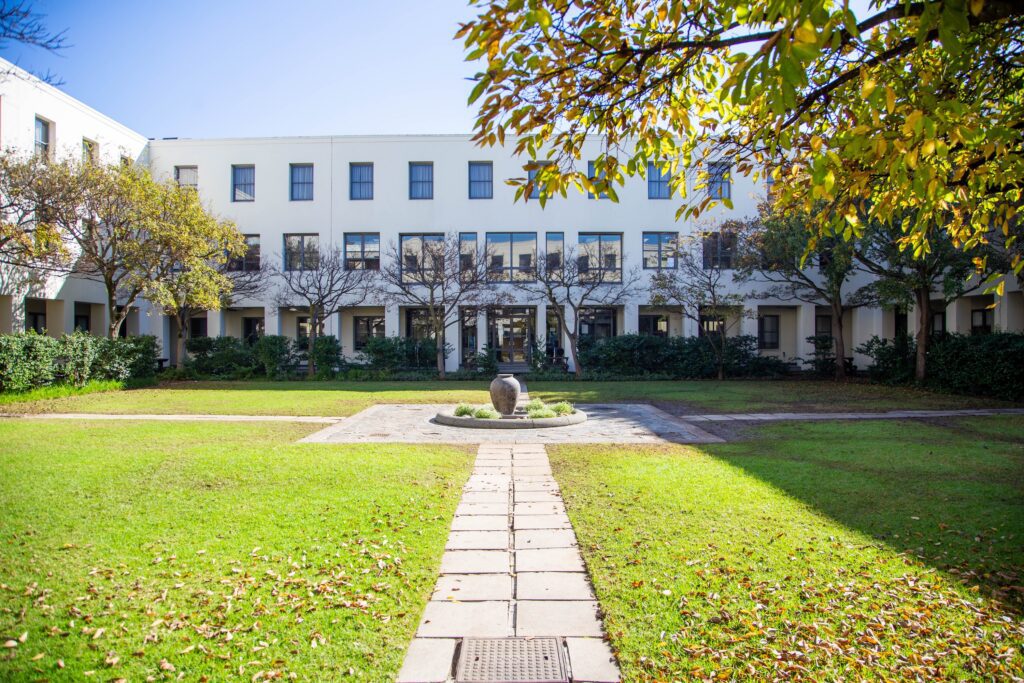
As many as 96% of graduates are employed or continuing their studies. Source: University of Cape Town
Cape Town: Where the advantage begins
But the real shift happens when students step beyond the classroom and into the world that surrounds UCT GSB.
A living laboratory for innovation and social impact, Cape Town contributes 10% to South Africa’s gross domestic product. South Africa’s second busiest container port is here, moving everything from citrus exports to automotive components. Natural assets are abundant and agricultural and tourism industries are established.
Lately, there’s been a surge in growth across some of the most cutting-edge industries today, from information technology to renewable energy and clean tech. Cape Town is also home to several initiatives, including the designation of the Atlantis Green Tech Special Economic Zone and several renewable energy companies’ headquarters.
For UCT GSB students, all of this becomes part of the learning experience — where global challenges and opportunities sit side by side, and where theory meets Africa’s real economy in motion.
Advance your career today with the CEMS MIM programme at the UCT Graduate School of Business.
Follow the UCT Graduate School of Business on Facebook, X, LinkedIn, and YouTube.