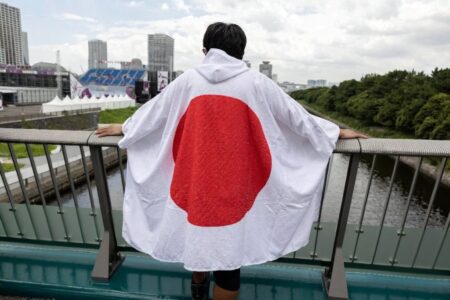



You’re offered a lot of new and exciting opportunities in university, and for Olivia Boissel, one of the biggest offerings that was laid out for her in her third year of undergraduate studies at Sciences Po was to choose between going on an exchange, doing an internship, or starting a personal project.
She chose the first and headed to study in Japan at Tokyo’s Waseda University.
“I thought it might be the only time in my life when I could immerse myself in a country so far away from France,” she explains.
At that point, Boissel had the rest of her life planned out for herself: complete her Bachelor of Arts and pursue the necessary requirements to become a judge in France.
“Back then, I thought I’d end up living in France forever as a judge,” she says. “It is quite a nationally bound profession with little international exposure.”
Little did she know that this single decision would change her life’s trajectory.

During her study in Japan, Boissel’s family made the long journey to visit her over Christmas. Source: Olivia Boissel
The start of something new
Tokyo stood out for several reasons, but there was a deeper, personal connection for Boissel too.
“When I was little, my parents were relocated to Singapore for work,” she says. “So, my idea of comfort food has always been fried rice — not cheese and baguette. Choosing to study in another part of Asia felt like reconnecting with a side of my childhood I really cherished.”
Her exchange in Tokyo left a lasting impression. “It was my first time in a truly international environment, which is what I was looking for,” she says. “At Waseda, I was living in a dorm with a lot of international students. That was, in itself a culture shock, for me.”
Boissel was determined to return to Japan. While interning at a French court, she realised that a France-bound career just wasn’t for her.
So, she switched to a master’s programme that gave her the chance to study abroad again. That decision paid off: during her second master’s, she earned a scholarship to study at the Tokyo University of Foreign Studies.

Boissel captured the view from her dorm at Waseda University during her study in Japan. Source: Olivia Boissel
Adjusting to a new way of life
Although Boissel was somewhat familiar with Asian culture, studying in Japan still came with its share of culture shock.
1. Organised systems
“I was struck by how incredibly organised everything is in Japan,” she says. “For example, if you’re on a train and something goes wrong, someone will immediately inform you.”
That level of communication and structure was very different from France. According to Boissel, “Trains and buses are often late. And nobody tells you they’re late, you will never know when they will arrive.”
2. Safety
Another factor that drew Boissel to study in Japan was its safety in public spaces.
According to World Population Review, Japan ranks #17 in the world for safety in 2025, far ahead of France at #85.
“Near Waseda, there’s a square where people often drink and sometimes end up sleeping through the night because missing the last train means an expensive cab ride. So, they just stay there or go to a 24-hour café.”
While passing out in public is not ideal, what stood out to Boissel was that no one disturbed them. “That sense of safety in public spaces was something I deeply valued while living in Tokyo as a woman, although Japan has its fair share of gender issues” she shares.
3. Communication
Something many international students going abroad to countries that speak a different language can relate to is the challenge of integrating into the local social culture.
“In France, we’re direct. If something doesn’t work for you, you just say no. In Japan, people often say ‘chotto’—which literally means ‘a little’—as a subtle way of declining,” Boissel explains.
“You’re expected to read between the lines. That was especially difficult for me because I tend to be honest and straightforward, which can come across as abrupt. Thankfully, people are generally understanding when you’re a foreigner.”
4. Socialising
Socialising in Japan is very different from France too.
“Spontaneity isn’t really part of the culture here. Calling someone on the same day or making last-minute plans is often seen as rude,” explains Boissel. “Even after living here for five years, I still hesitate to call friends without planning ahead.”

Boissel (middle) with four UWC ISAK Japan alumni who helped her plan a three-day reunion in Karuizawa for around 50 graduates. Source: Olivia Boissel
Lost in translation
When most people say they want to study in Japan, it’s often because they’re fans of anime. That wasn’t the case for Boissel.
“I actually wasn’t well-versed in Japanese culture at first,” she admits. “I did love Studio Ghibli films growing up, and my uncle, who used to live here, used to tell me about it. But beyond that, I didn’t know much.”
This limited exposure made the early days during her study in Japan especially tough. “I was really lost,” she says. “Turns out you can’t really learn the language without understanding the culture.”
“Our first Japanese lessons were all about politeness levels and social norms, but none of it made sense to me. My classmates had watched anime, read manga — I didn’t, so I often struggled to follow what we were learning.”
Still, she persevered. “I learned the most outside the classroom, by talking to people, hanging out with friends, and joining events and activities,” she says.
Eventually, she turned to self-study.
“I’ve always been a bookworm, so I dove into grammar books and studied for Japanese proficiency tests. The language classes at Waseda moved slowly, and I needed to speak Japanese to get by in daily life. That need to survive really pushed me to learn on my own.”

Boissel’s go-to activity during her study in Japan was hiking. She did it nearly every weekend. Source: Olivia Boissel
Tips to study in Japan
To learn Japanese, Boissel tackled not just one writing system but four: kanji, katakana, hiragana, and romaji.
“When most people start learning Japanese, they start with katakana and hiragana and don’t learn kanji.”
But she recommends otherwise. “If you don’t learn kanji, you can stagnate very fast in your Japanese studies, because you need them to read things in the streets, read menus, read books, read newspapers.”
Boissel also has practical tips for anyone learning Japanese, starting with how you should find a method that works best for you.
1. Find what works for you
“Everyone has different learning styles and preferences,” she says. “I know that my way of learning is really not popular, but I just read grammar books.”
She also used Anki, a memory app. (Fun fact: Anki means memorisation in Japanese)
“I would create digital flashcards on my phone and computer, and every day I’d review Japanese characters, vocabulary, or verbs. What’s great is that the app shows you a card just before you’re about to forget it, which is proven to help with long-term memory.”
2. Get to know the culture
Her second piece of advice before you study in Japan: immerse yourself in the culture and find something you genuinely enjoy.
“For Japan, it’s very easy. People usually get into it through anime or manga,” Boissel says. “But it could be anything, such as art, politics, literature.”
She encourages learners to explore content in the target language, whether that means reading articles, subscribing to newsletters, or listening to podcasts. “It’s all about making the process fun.”
Now in her fifth year in Japan, Boissel has fully embraced this approach. She enjoys listening to Japanese music and radio, finally binge-watched “Attack on Titan” and has gotten interested in reading contemporary Japanese books and manga.
Popular stories
7 inspiring movies every student must watch

The ultimate international student guide to visa fees, from lowest to highest cost

Internship, master’s, and PhD application tips from a Purdue scholar (who was rejected 14 times)

US$179,902 per year: 10 most competitive dentistry schools in the US and how much they cost