





The University of Fribourg’s Institute for International Business Law (IBL) aims to prepare students for a legal profession that is constantly evolving.
In Spring 2025, while preparing to introduce Artificial Intelligence (AI)-focused courses, they saw a strong interest in AI among students. These first sessions were delivered by Professor Pascal Pichonnaz, President of the IBL, Professor at the University of Fribourg, former President of the European Law Institute, and prolific author — anchoring the topic of AI and the Law in solid legal scholarship.
AI was no longer a distant concept. Students were encountering it in internships, in research tools, and — for many working professionals — in their own legal practice.
The institute approached these early courses with genuine curiosity, alongside a very real question: what does AI mean for my future as a lawyer?
In Fall 2025, IBL launched the CAS in AI and the Law — designed not as a technical programme, but as an exploration of the legal and governance dimensions of how AI is reshaping professional environments.
Among the first participants was Paola Villarreal, who joined with a strong interest in understanding how AI is shaping the legal profession. Over the course of the programme, this interest developed into a deeper appreciation of its practical implications for her work.
As she later reflected: “Today, I see AI less as a technology topic and more as a governance challenge that legal, risk, compliance, and IT functions must address together.”

Villarreal has spent over a decade advising high- and ultra-high-net-worth families on wealth structuring, succession planning, and cross-border compliance at leading institutions including Credit Suisse and Julius Baer. Source: University of Fribourg
For many participants, this marked an important shift: AI was no longer viewed simply as a technological development, but as something that shapes how decisions are made, responsibilities are defined, and risks are managed across organisations.
Throughout the Fall semester, students explored how AI is already intersecting with legal work — from its role in contract lifecycle management to questions of data privacy, intellectual property, cybersecurity, and the emerging regulatory landscape surrounding AI.
The semester concluded with a panel discussion bringing together academics, lawyers, and business leaders to share what is actually happening inside organisations today. The discussion reflected practical experience rather than theory. Panelists described how AI is already being integrated into legal work, and how its use is increasingly expected.
As one panellist noted: “AI is here to stay, and it has the power to transform all different industries, including the legal industry.”
A recurring theme throughout the discussions was the continued importance of human judgment. AI can support analysis and automate repetitive processes, but responsibility remains with the legal professional. Understanding how to work with these tools — rather than delegating judgment to them — is becoming a key professional capability.
The success of the Fall semester marked an important step.
What began with a small number of exploratory sessions in Spring 2025 has since developed into a permanent part of IBL’s educational offering.
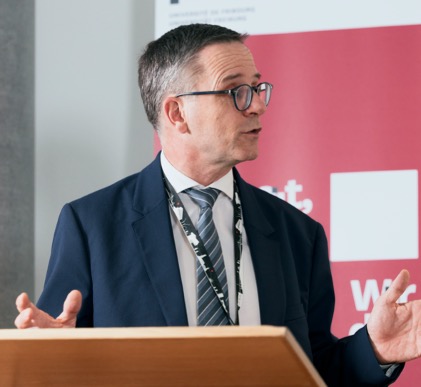
Professor Pichonnaz is an internationally recognised scholar in European private law and dispute resolution, with particular interest in the evolving legal frameworks surrounding artificial intelligence. Source: University of Fribourg
As of Spring 2026, the CAS in AI and the Law is now an established programme, continuing to build on topics such as legal contracts and the EU AI Act while expanding into areas including AI governance in HR and ethical considerations.
Today, the programme has become part of the broader learning journey at IBL — available both within the CAS and to LL.M. students who wish to deepen their understanding of how AI is shaping professional environments.
In an increasingly competitive legal environment, AI literacy is beginning to distinguish professionals who can engage confidently with emerging tools from those who remain hesitant. Rather than replacing legal expertise, this understanding enhances it — allowing lawyers to ask better questions, interpret outputs critically, and contribute more strategically within their organisations.
Legal departments increasingly expect lawyers to understand how AI influences decision-making in the same way they expect familiarity with compliance or data protection.
What is unfolding is not a story of replacement, but of adaptation.
AI is changing how legal work is done, while reinforcing the importance of human judgment, responsibility, and critical thinking.
Helping students understand and navigate this shift has become an integral part of preparing them for the profession — because understanding AI is no longer an additional skill, but is becoming part of what it means to be a lawyer today.
Follow Fribourg Law School on Facebook, Twitter, YouTube, Instagram and LinkedIn