

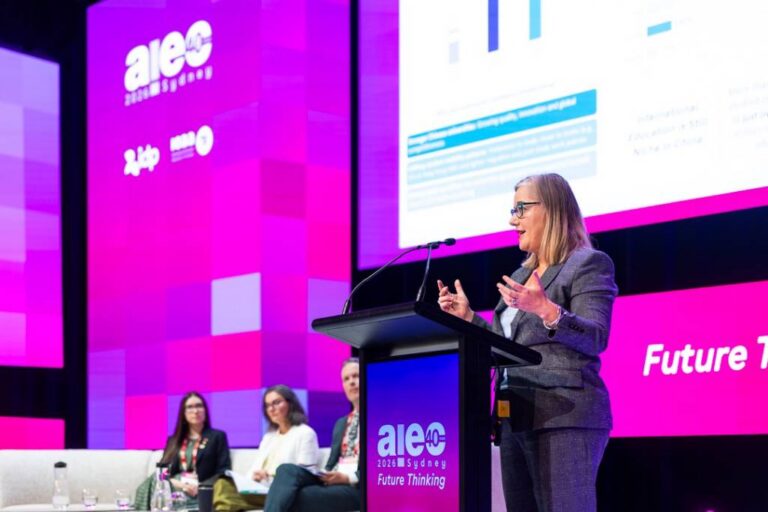


International education is undergoing significant change. Government policies are evolving, student expectations are shifting, and new technologies are reshaping how students explore their options around the world.
Against this backdrop, education leaders, policymakers, and innovators gathered in Sydney from 27th to 30th October for the 40th Australian International Education Conference (AIEC).
Co-hosted by IDP Education and the International Education Association of Australia (IEAA), this year’s conference embraced the theme “Future Thinking,” exploring the ideas that will shape the sector’s next chapter.
Here are our five key takeaways about international education from the conference:

While the US, UK, Australia, and Canada remain firmly established as leading study destinations, international students are broadening their horizons to other countries, namely Germany, Turkey, Japan, France, the Netherlands, and Argentina. Source: Andy Barbour/Pexels
1. Transnational education takes centre stage
International education has traditionally been associated with students travelling overseas to pursue their studies. But that model is evolving.
In his address on 27 October 2026, Minister for Education, the Hon Jason Clare MP, highlighted the growing importance of transnational education (TNE).
“Education is the most powerful force for good in this world. It changes lives. And changes countries. Our universities, all of our higher education institutions, do that every day,” he says. “Not everyone can come here to study. Not everyone can afford it. But we can come to them.”
Australian universities are expanding their presence across Asia and beyond, with campuses in countries including Malaysia, Vietnam, Singapore, Indonesia, India, and the United Arab Emirates.
Further developments are underway, including Western Sydney University’s planned campus in Greater Noida, India, and RMIT’s newly approved campus in Hanoi, Vietnam.
“What we do here has a reputation that rings around the world. It’s why we are invited to set up campuses around the world,” Minister Clare added.
2. Students have more choices, and their expectations are changing
Rather than focusing on a single country, students are comparing institutions and opportunities across multiple destinations. Many are keeping their options open for longer and holding multiple offers.
Affordability, visa certainty, post-study work opportunities, and career outcomes are becoming increasingly important considerations.
Australia remains a highly attractive destination, with research presented at the conference identifying it as the most considered study destination globally, at 54%. However, policy uncertainty is influencing student perceptions and decisions.
Another important insight was the growing value of authentic student experiences. As AI-generated information becomes more widespread, prospective students increasingly want to hear directly from their peers about what studying abroad is really like.
3. AI is transforming more than the study experience
In his keynote, futurist Michael McQueen explored the accelerating influence of AI and the importance of preparing for long-term change.
Where traditional online searches present users with a list of websites to explore, AI-powered search tools increasingly provide direct answers to questions. This creates a new challenge for education providers: how can institutions ensure their information is visible, credible, and relevant when students turn to AI for guidance?
McQueen also highlighted changing communication preferences among younger generations, with 51% preferring TikTok over Google search.
4. Employability and real-world outcomes are becoming central to education decisions
Students and families are placing greater emphasis on return on investment, career opportunities, and the practical relevance of academic programmes.
This is particularly evident in markets such as China, where changing economic conditions and growing competition among universities are influencing education decisions.
Students are seeking programmes that connect academic learning with industry experience, practical skills, and future employment opportunities. Work-integrated learning, internships, and industry partnerships are becoming important differentiators.
Flexibility also matters. Programmes offering dual qualifications, international exchanges, or opportunities to complete part of a degree overseas can help students keep their future options open.
5. The future of international education depends on stronger partnerships
Another recurring theme throughout the conference was the importance of collaboration.
As international student mobility evolves, partnerships between institutions, governments, and industry are becoming essential to creating sustainable education opportunities.
This was particularly evident in discussions about China, where the international education landscape is changing.
Although more than 570,000 Chinese students studied overseas in 2025, outbound mobility has declined from 2019 levels. Stronger options at home, shifting economic conditions, and changing student preferences are contributing to this trend.
Rather than viewing international education solely through the lens of students travelling abroad, speakers encouraged institutions to consider more flexible and collaborative models.
These include joint colleges, dual qualifications, research partnerships and structured pathways that allow students to begin their education in their home country before progressing overseas.
One example shared was the Xinxiang University–Melbourne Polytechnic, which enables students to complete their studies in China while earning qualifications from institutions in both countries.
Successful partnerships, however, require more than establishing a programme.
Conference discussions highlighted the importance of shared values, complementary strengths, consistent quality, meaningful student experiences, and a long-term commitment to collaboration.
Popular stories
Cafés, vintage shopping, pizza: The best way to spend your first 24 hours in Tokyo as an international student

Make your next big career move with Vanderbilt University’s MBA

10 best free textbook websites for students in 2026

The best scholarships in South Korea for international students in 2026