

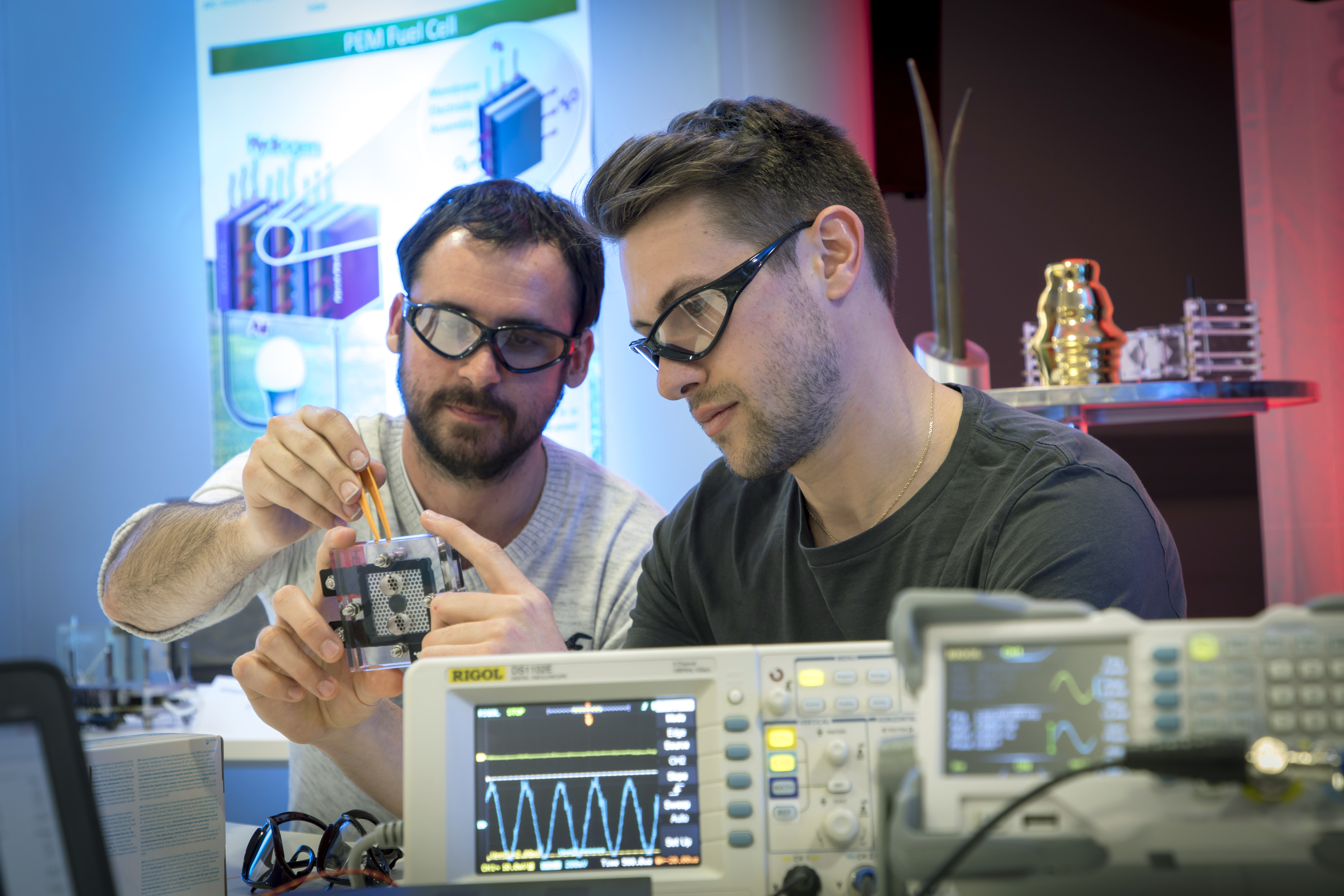


Katarina Stanojevic may have first joined Graz University of Technology to earn a bachelor’s degree in electrical engineering. Then, the Serbian student was drawn to the appeal of learning German and immersing herself in a new culture in Austria’s second-largest city.
But what made Stanojevic stay and continue with a master’s in Electrical and Electronics Engineering was something else: the many experiential learning opportunities here.
“I was already impressed by the supportive atmosphere and the balance between theory and application in the bachelor’s programme, and during my studies, I started working as a student assistant at TU Graz — an experience I really enjoyed and wanted to continue throughout my master’s,” she says “Combining academic learning with hands-on work helped me deepen my understanding of the field and strengthened my motivation to stay connected to the university environment.”
With this experience in hand, Stanojevic is excited about the future of the field – and her role in it. She sees the rapid development of artificial intelligence, automation, and digitalisation transforming every area of engineering and constantly expanding what is possible.
“As technology evolves, we as electrical engineers evolve with it — and that is the real beauty of this field,” graduate Katarina Stanojevic says. “These developments are truly inspiring, and I believe that the most valuable part of our education lies not only in mastering specific tools or methods, but in learning how to think — to adapt, analyse, and approach new challenges with curiosity and structure.”
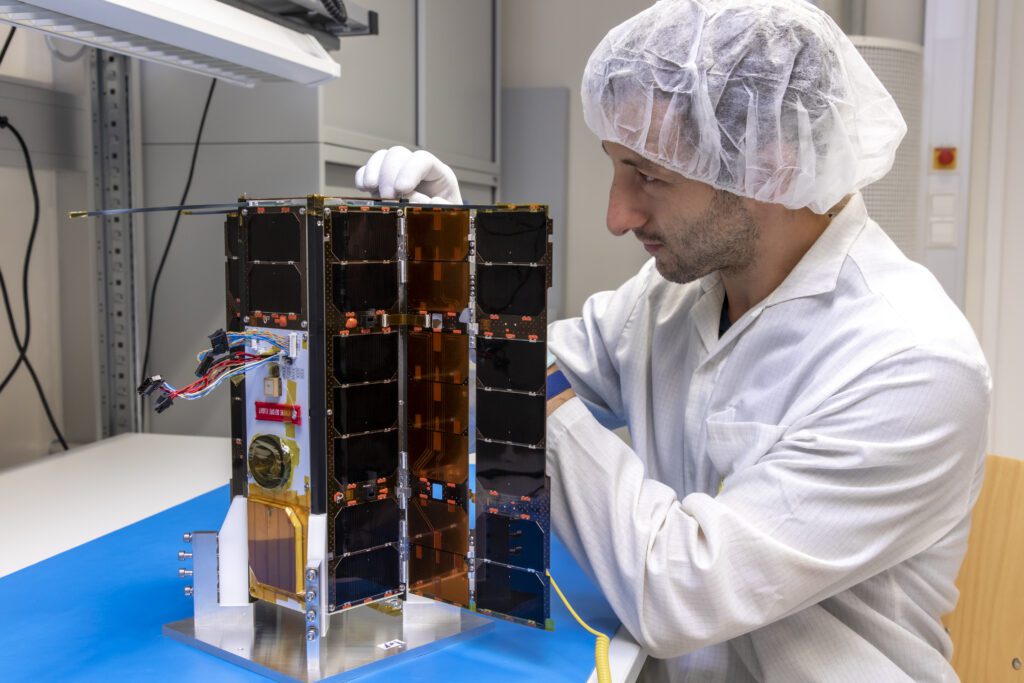
The master’s programme in electrical and electronics engineering addresses the field’s rapid digitalisation. Source: Graz University of Technology
The EEE Master’s programme reflects the broad scope and innovative potential of electrical and electronics engineering. Stanojevic was not being dramatic about the field’s rate of growth. The world today relies on electrical engineering. From our smartphones and smart homes to our energy supply, e-cars, and Industry 4.0, this is a field that will be key to developing the technologies that shape our world both today and tomorrow.
The curriculum prepares students for this. Spanning four semesters and taught in English, modules cover technical know-how and the application of scientific methods to systematically develop cutting-edge solutions for professional challenges. These cover a diverse range, such as green and sustainable energy supply systems, electromobility, secure communication networks, industrial automation and robotics using AI, and energy efficient integrated circuits.
Research is a key part of the programme. The faculty is home to 12 institutes alive with activity that are trendsetting and leading in Austria in many applied and theoretical areas. For example, the Institute of Communication Networks and Satellite Communications received US$9.7 million in research funding to develop Internet of Things (IoT) devices that can operate without a dedicated power supply.
Stanojevic herself was part of the Institute of Automation and Control, where she investigated how network effects influence the performance of control systems. “One of the most impactful courses here was Optimal Feedback Design, where I was first introduced to the concept of networked control systems — an exciting yet challenging topic that integrates control theory with communication technologies,” she says. “Tackling such an interdisciplinary topic required combining theoretical understanding with creative problem-solving and elegant mathematics. This experience sparked my curiosity about the interplay between control and communication and ultimately motivated me to pursue this topic further.”
Other institutes within the faculty include the Electric Drives and Power Electronic Systems Institute, the Institute of Electrical Measurement and Sensor Systems, the Institute of Electrical Power Systems, the Institute of Electricity Economics and Energy Innovation, the Institute of Electronics, the Institute of Fundamentals and Theory in Electrical Engineering, the Institute of High Voltage Engineering and System Performance, the Institute of Microwave and Photonic Engineering, the Institute of Signal Processing and Speech Communication, and the Institute of Technical Informatics.

You have the opportunity to work in state-of-the-art laboratories like the Nikola Tesla Laboratory, the antenna measurement chamber, and the Christian Doppler Laboratory. Source: Graz University of Technology
The EEE Master’s programme lets students choose their path: theory, research, or industry. Stanojevic was drawn to the depth of theory, so she chose courses focusing on control engineering that had strong scientific foundations and paired them with advanced and targeted laboratory courses that let her test control systems, study how they behaved, and connect theory to real-world setups. “In my case, the thesis was designed to align with my goal of continuing in research and pursuing a PhD,” she says.
Today, Stanojevic is a University Assistant at the Institute of Automation and Control at TU Graz. Her role combines developing and lecturing courses, supervising student projects and laboratory work, and conducting research in the field of networked control systems. She finds the position “highly dynamic and rewarding” as she gets to collaborate with many motivated students, present research at international conferences, and exchange ideas with colleagues from different disciplines.
“This combination of rigorous coursework, targeted laboratory work, and early exposure to research and teaching shaped my decision to remain in academia and equipped me with the skills I now apply daily in my professional role.”
EEE graduates are in high demand. They are key to research, development and production departments in sectors such as energy supply, telecommunications, automotive, and more. In these roles, they are responsible for the research and development in all areas of electrical engineering and information technology; planning of electrotechnical systems for machines, plants or buildings; implementing these planned systems; and integrating electrotechnical solutions into social and economic areas.
Follow Graz University of Technology’s Faculty of Electrical Engineering and Information Technology on Facebook, Instagram, and YouTube.