

A business degree can open doors, but building a career in today’s global economy takes more than knowing how businesses work. You’ll need to understand how technology is changing industries, work with people from different cultures, and make sense of challenges that rarely have straightforward answers. This is where ESCP comes in.
With six campuses across Berlin, London, Madrid, Paris, Turin and Warsaw, ESCP offers a distinctly European approach to business education. International experience has long been embedded into its student journey, alongside a keen understanding of many cultures and how business works across borders.
ESCP is building on this foundation through its Bold & United strategy for 2026–2030. The plan connects business with technology and global affairs through three schools: the Business School, ESCP’s historic core and the world’s oldest business school (1819); the School of Technology (2027); and the School of Governance (2029).
The reasoning behind this is simple: the world of work is changing, and tomorrow’s leaders need more than a traditional business education.Through its AI initiatives, ESCP encourages students to understand technology and use it responsibly. Its focus on ethics, responsibility, and sustainability also challenges them to think about the wider impact of their decisions. The aim is to help you think critically and lead with purpose.
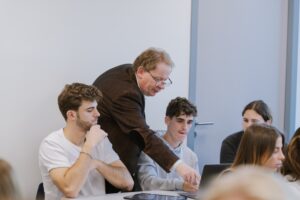
ESCP’s multi-campus model exposes students to diverse cultures, business environments, and perspectives. Source: ESCP
What makes ESCP’s multi-campus experience different from an exchange programme?
An exchange programme usually offers a temporary experience at just one partner institution. Usually optional, this means students have to apply and prepare for the exchange programme alone and without the support of their university.
By contrast, at ESCP, international learning in multiple countries is built into the degree itself. Every programme requires students to study on at least two different campuses.
For example, students in its Master in Management programme get to live and learn across two to five European countries. ESCP Bachelor students study in three different countries over the course of three years. Rather than navigating a single relocation on your own, your move across campuses is backed by the school’s full support.
What can studying in different countries teach that a classroom cannot?
A classroom can introduce you to different cultures, but living in another country lets you experience them firsthand. As you settle into a new environment, you’ll begin to understand different perspectives and learn to adapt to unfamiliar ways of life. ESCP’s 2026 Live, Learn & Love in Europe survey reflects this appeal. Among more than 900 students and recent graduates surveyed, 91% were satisfied with their quality of life in Europe, while 89% felt aligned with the European way of life.
With ESCP, you can live and learn in different European cities and develop the cross-cultural agility, resilience and confidence needed to work across borders.
How can ESCP help you prepare to work across countries, cultures, and markets?
According to the 2026 Financial Times ranking, 98% of ESCP’s Master in Management students were international, alongside 94% of international faculty. This diversity creates important early opportunities to learn from people with different experiences and perspectives. ESCP’s strategy builds on that foundation by bringing business, technology, and governance into the conversation, helping you connect ideas not only across various cultures and backgrounds but also across disciplines and industries.
For over 200 years, ESCP as developed responsible leaders who drive innovation and create sustainable impact. Source: ESCP
How can you future-proof your career?
No university can predict exactly which jobs will exist in 10 years. But you can build the skills and mindset to adapt. The World Economic Forum’s Future of Jobs Report 2025 estimates that 39% of workers’ existing skills will change or become outdated by 2030. It also found that 86% of employers expect AI and information-processing technologies to transform their businesses. ESCP is responding by making AI literacy part of its educational approach. The school has developed several partnerships with AI tools, making them available across its community and offers more than 17 AI- and digital-focused programmes.
You’ll need technical competence to work with these new tools, but also critical thinking to assess their output. Future-proofing isn’t about using new tools and chasing new trends. It’s about staying curious and being ready to learn.
How does ESCP teach responsible leadership?
Leadership is not only about making decisions that benefit a business. It is also about understanding who else those decisions affect, from employees and customers to communities and the environment. That is why sustainability sits at the heart of ESCP’s approach to responsible leadership.
At ESCP, sustainability is integrated into teaching and student life. The school reports that 100% of its students receive sustainability training.
Students put these lessons into practice through initiatives such as Ma Petite Planète. Its 2026 challenge involved 1,166 participants, who collectively avoided more than 100 tonnes of CO₂-equivalent emissions and saved over 24 million litres of water. The aim is to help students move beyond understanding sustainability as an abstract concept and consider how their decisions can create meaningful change.
How does ESCP help students build a career in Europe?
ESCP’s 2026 survey found that 90% of respondents were likely to work in Europe after graduation, with work-life balance and career opportunities among the main attractions. Its Master in Management programme also reports that 100% of graduates found employment within three months. Ranking #1 in the world and #1 for career services by the Financial Times, ESCP’s Master in Finance achieves 100% employment upon completion of the programme with 82% of students finding jobs with an international dimension. ESCP’s European Careers Centre, which operates across campuses and countries, also helps connect students with opportunities throughout Europe and beyond.
Of course, studying in Europe doesn’t automatically guarantee a job. A degree from a school like ESCP can provide a strong foundation, but you should also research local markets, understand employer expectations, develop language skills, and get familiar with workplace cultures. Your international experience also gives you a useful starting point: the confidence to enter unfamiliar environments, and the perspective to work with different people.
Follow ESCP on LinkedIn, Instagram, YouTube, Facebook, and TikTok.