


Anitha Raj’s day starts early, and when I mean early, she’s up and ready by 6 a.m. to head over to the University of Atacama.
“I wake up early, by 6 a.m., but I usually aim to start my day at around 7 a.m.,” she shares. “I’ll head over to uni, get to my desk, and check my emails. Once that’s done, I’ll start writing up my schedule for the day and check if I have any meetings with my supervisor or anyone else.”
As a PhD student in Astronomy, Raj has to work with data.
“I have to reduce data, and this is the toughest task of the day,” she says. “I have to do it through a programme that takes forever to run, so I usually leave that to process in the background. Then I’ll start working on producing the data.”
Once that’s done, Raj will then work on her papers until lunchtime. After having a meal, she’d return to her papers and work on improving the technical aspects of it. She would also look for topics to support her claims and design illustrations for her paper.
Raj will do this till 5 p.m. or 6 p.m. She’ll pack up and head out into the city to meet friends or have some refreshments.
By 9p.m., she’s in bed — and it’s a rinse and repeat kind of life.
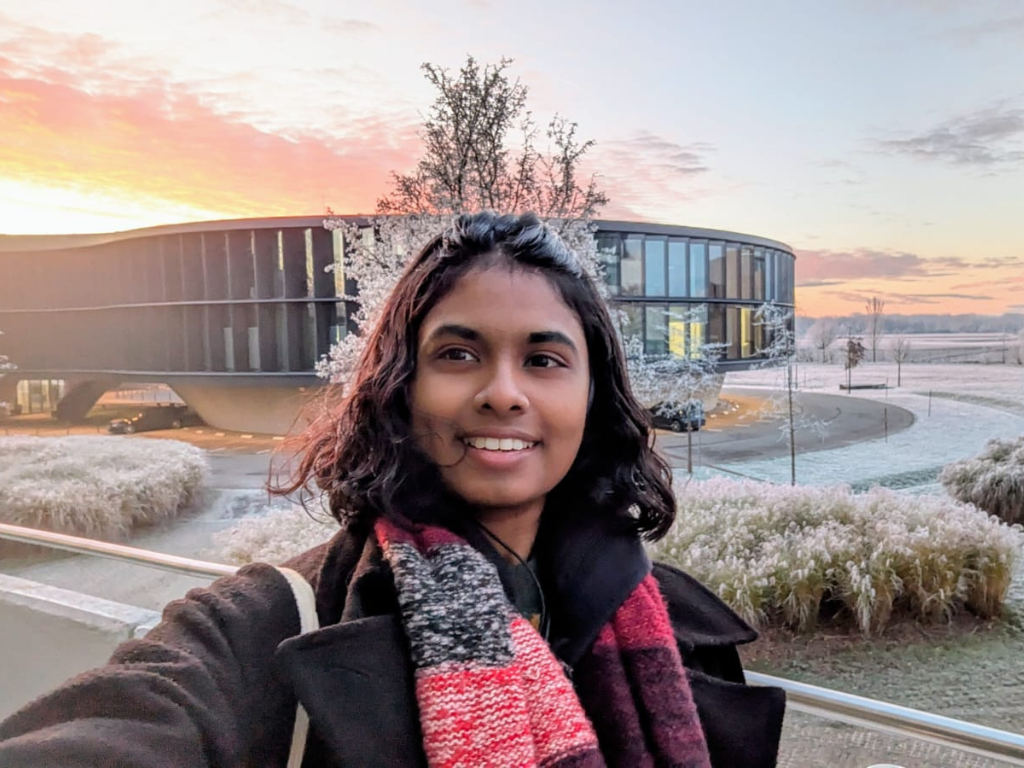
Raj completed a BSc in Physics from Dr. MGR Educational and Research Institute and an MSc in Physics from DG Vaishnav College. Source: Anitha Raj
Up all night version: Day in the life of an astronomy student
You’re probably wondering, “That’s it? That’s a day in the life of a PhD astronomy student?”
Well, no. It gets better.
Depending on the department’s schedule, Raj will spend 14 consecutive days at the La Silla Observatory, an astronomical observatory in Chile that features three telescopes built and operated by the European Southern Observatory.
“So what usually happens is that we have to switch our schedules around, meaning our day starts at 5 p.m.,” Raj explains. “We’ll head over to the telescopes at around 5 p.m. to 5:30 p.m., and that’s when our all-nighter starts.”
Raj and her cohorts will set everything they need up in the observatory. But before the main event, they’ll have to come up with calculations as part of their research.
Once that’s done, the observation of exoplanets, LEOsat observation starts — and it will last all the way till 5 a.m. to 6 a.m.
“That’s how long it will last, and we’ll be up all night,” Raj laughs. “We’ll clear up and head back to our dorms to sleep at around 7:30 a.m. We’ll wake up eight hours later, and it’s the same cycle again for over 14 days.”
Where is the best place to study astronomy?
As crazy as her schedule can be, Raj finds beauty in it. One of the main reasons is that she’s pursuing her PhD in Chile.
“There are a few reputable universities that dedicate themselves to astronomy all over the world, some are in the US, Germany, and Australia,” Raj shares. “However, when it comes to astronomy observatories, Chile is home to famous ones: Paranal, La Silla, and ALMA Observatory.”
Why? Well, it’s because of Chile’s clear skies.
“We can see the Milky Way with our naked eyes, and it’s pretty amazing,” she says. “The thing is, not even the locals are aware of how clear the skies are.”
Chile has one of the world’s darkest skies due to its far distance from light pollution — perfect for astronomy students to conduct their fieldwork.
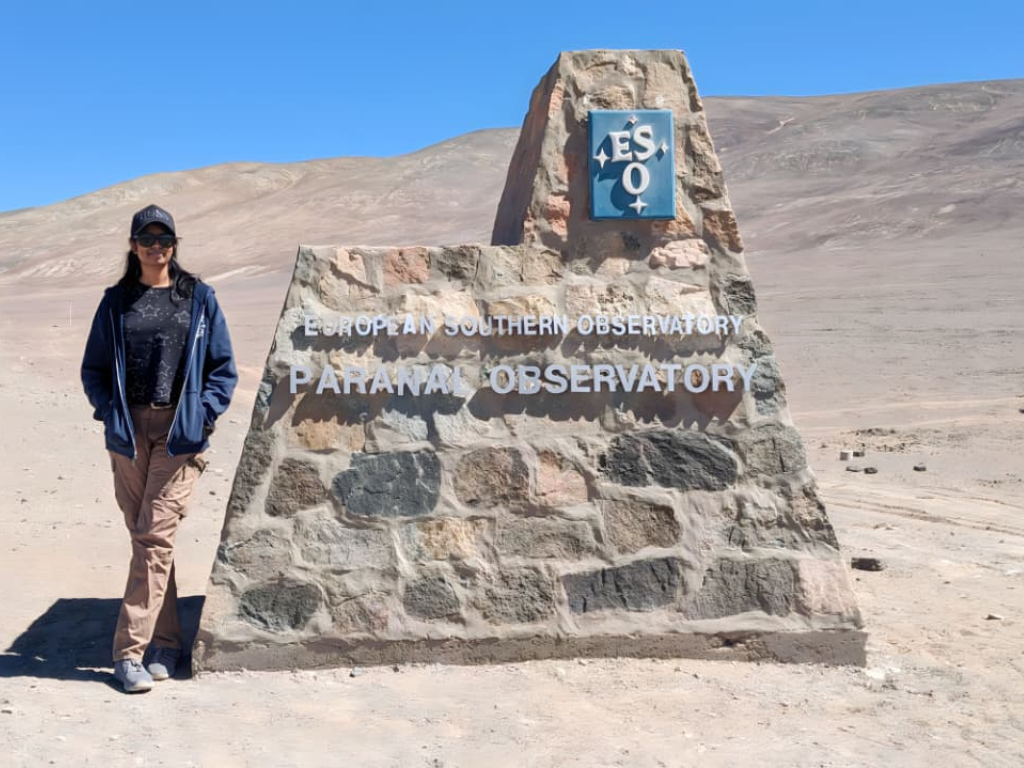
Raj has completed her Studentship at the European Southern Observatory, Garching headquarters. She is currently in Chile to defend her thesis. Source: Anitha Raj
It’s safe to say that Chile isn’t exactly a top choice for international students to pursue their degree. In 2019, approximately 10,300 international students were enrolled in Chilean universities, with the majority from Peru.
But Raj is here to change minds.
“It’s been amazing studying in Chile,” she shares. “It was hard at first because of the language, but after learning it for a few months, it has gotten better. People here are very nice too, and they’re extremely patient when you try talking to them in Spanish.”
When Raj first made her way to Chile, she lived on the Spanish she had learnt on Duolingo.
“They would stand there smiling while I tried to complete a sentence,” Raj laughs. “It’s different from when I was completing my internship in Germany. In Germany, people don’t exactly have much patience when you try to speak to them in German, and they aren’t exactly as friendly — to me at least.”
When it comes to food, it was a little hard for Raj to adapt. Born and raised in South India, she grew up eating really spicy food. However, food in Chile is … sweet.
“I prefer spicy food, but Chilean food is so sweet,” Raj laughs. “It’s as sweet as their people. So, unfortunately, I have to cook my own food.”
Despite all that, Raj has no regrets. While Chile is half a world away from home, she has found her niche in the country’s astronomy field.
“Yeah, attending the best universities in the world is important, especially if you’re looking to work towards the modelling part of astronomy and don’t depend on observation,” Raj smiles. “But if you’re looking for the other, then Chile is the place to do it.”
Popular stories
How to learn Korean fast: 8 best K-pop songs for beginners

The five countries most in need of nurse practitioners — with pay up to US$110,433 a year

EXO Kai’s LACOSTE era is serving elite energy — like the study history of past, present EXO members

Sorting your career: Find your best career based on your Hogwarts house