



When considering a PhD, it’s important to think of the “why.” Are you looking for a career boost? Do you seek new transferable skills? Are you passionate about research and want to make a contribution to your subject? When you know what drives you, it becomes easier to identify the environment that will support that ambition — a university with the right mentors, intellectual community, and research culture.
If you’re looking to pursue a PhD in the liberal arts, the Morrissey College of Arts and Sciences at Boston College (BC) offers precisely that kind of environment. Interdisciplinary programmes here aim to shape the whole person — intellectually, socially, spiritually. Students are encouraged not only to prepare for their careers, but to examine what kind of life they hope to lead. They learn to connect past and present, theory and practice, contemplation and action.

Ira Abraham. Source: Boston College
Connection grows beyond classrooms, too. For Ira Abraham, a PhD student in Economics from Kerala, India, the graduate community at Boston College has been just as formative as the academic environment itself. Activities hosted by the BC Grad Student Association and the Office of International Students and Scholars (OISS) expanded both her network and perspective.
“I got to experience the famous Boston Duck Tour. There was also an event called ‘Study by the Sea’ that took a few of us graduate students for an overnight stay at a quiet, beautiful house where we could work and enjoy nature,” she shares. “These and many more such experiences have been truly invaluable highlights. I am grateful to be part of the BC community.”
The following stories show what the Morrissey PhD experience looks like in practice.

The Graduate School of the Morrissey College of Arts and Sciences at Boston College offers 29 master’s and PhD programmes across the humanities, social sciences and natural sciences. Source: Boston College
Learning how to teach, learning how to listen
Doctoral study is a different rhythm altogether. Unlike undergraduate study — experiences shared widely — graduate research often unfolds quietly, in archives and seminar rooms, far from the rhythms of everyday life. Finding intellectual companionship can be as challenging as the research itself.

Maria Gallego-Ortiz. Source: Boston College
Still, Maria Gallego-Ortiz, originally from Bogota, Colombia, has never truly felt the need to brave her PhD alone. “People are direct and helpful, and I’ve felt that faculty and staff are genuinely invested in students’ progress”, she says.
Gallego-Ortiz is currently in her third year of the PhD in Philosophy, a Humanities programme at BC. It centres the history of philosophy, with a particular focus on contemporary European thought. Candidates are trained in teaching, philosophical research, and writing.
They serve as research assistants, attend teaching seminars, and lead their own undergraduate courses. The work culminates in a dissertation, but the formation extends well beyond it.
Professor Richard Kearney’s classes in particular reshaped her expectations. “His seminars raised my expectations for what philosophical work can look like: careful, historically informed, and still connected to the questions that matter outside the classroom,” she says. “I left those courses with clearer research questions and a stronger sense of direction.”
Mentorship is one of BC’s strongest points. Students are assigned an advisor early on, and as they discover a research focus, they’re supported in choosing a dissertation supervisor. Professor Kearney is now Gallego-Ortiz’s. He and his peers are leading experts in their fields, but that doesn’t mean they’re hard to approach. In fact, it’s quite the opposite. Conversations extend beyond formal office hours, and feedback is always encouraged.
Such guidance is crucial for students, as advising can lead to opportunities beyond the classroom. This year, Gallego-Ortiz is a doctoral fellow at the Clough Centre for the Study of Constitutional Democracy, with the programme theme Democratic Resilience. “The fellowship brings together doctoral students from different disciplines — history, education, social work, political science, psychology, etc. — which makes the conversations genuinely interdisciplinary,” she says. “What’s been most valuable is seeing how the same problem looks different depending on your training.”
It is in these moments, at the intersection of philosophy and lived experience, that the liberal arts reveal their contemporary relevance. The experience she’s gaining perfectly complements what she’s learnt at BC, in and out of the classroom. Through the PULSE programme for undergraduate students, which partners with marginalised communities to enact social change, Gallego-Ortiz found her teaching evolving.
“I’m more intentional about making the material accessible without simplifying it, and I’m more attentive to the different backgrounds students bring into the room,” she says. “I’m motivated by the idea of bringing what I’ve learned back home and contributing to academic life and philosophical education there.”
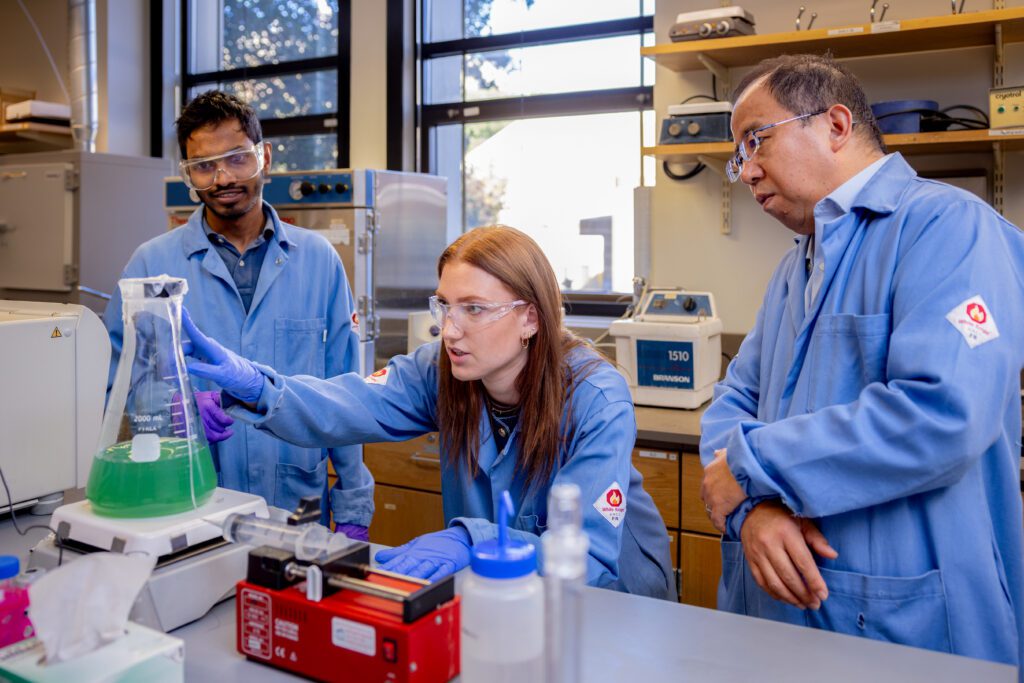
The Morrissey College has approximately 800 graduate students and 550 full-time faculty. 43% of its graduate population are international students. Source: Boston College
Science across boundaries
Philosophy teaches students to examine ideas; chemistry challenges them to test those ideas. At Morrissey, the two are not so different.
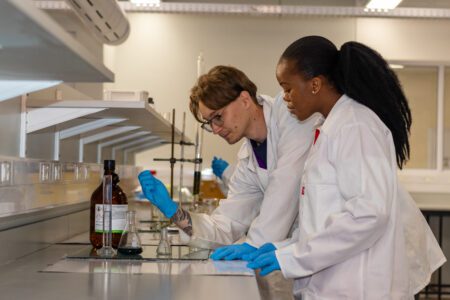
For Qi (Tony) Dong from Cangzhou, China, who earned his PhD in Chemistry, collaboration was the condition that made it possible. An electrochemist by training, Dong found himself working alongside organic and polymer chemists to develop an electrochemical polymerisation process capable of producing biodegradable polymers.

Qi (Tony) Dong. Source: Boston College
“Most of BC’s programmes and departments are not too large,” he says. “Within a smaller community, people are closer to one another and know each other’s work better. This contributes to frequent exchange of ideas and fosters collaborations.”
The PhD in Chemistry is structured less around ticking off credits and more around intellectual depth. Instead, students are expected to demonstrate mastery of one or more subfields. The first year builds a broad foundation before narrowing into specialised research. Along the way, students pass a second-year oral exam, teach undergraduate courses, complete a dissertation, and present their findings — both orally and in poster form — at the Graduate Research Symposium.
For Dong, the defining feature was the rigour of the work itself. Over five years, including three concentrated on his doctoral research, he investigated super-concentrated electrolytes for batteries and advanced chemical synthesis. This has led to several published papers and over 200 citations.
Dong’s research group also worked closely with a visiting Physics scholar, an opportunity that began when the scholar reached out directly to borrow some instruments from their lab. “The research groups and labs at BC are very open to collaboration,” says Dong. “We began working together in the lab, where we discovered more ways to come together professionally.” Years later, they remain in touch — now as faculty members and leaders of their own research groups.
Like Gallego-Ortiz, Dong found academic advising and mentorship integral to his BC experience. Not only did his advisor work with him on specific projects, but he also taught him how to conduct research from a broader scientific perspective. Today, as an Assistant Professor at Purdue University, Dong directs his own lab as an independent principal investigator. The environment he cultivates reflects what he once experienced. “I apply mentoring strategies and styles very similar to those I learned from my advisor at BC,” he says.