





Nothing puts our small existence into perspective quite like staring into the vastness of a clear night sky. It’s peaceful, serene — but also an infinite, mysterious void full of questions we haven’t yet answered.
For Anitha Raj, a PhD candidate earning her astronomy degree at the University of Atacama, that cosmic curiosity is her career. Her days (and plenty of nights) are spent studying planets beyond our solar system — distant worlds orbiting stars light-years away.
From observing ultra-hot gas giants known as “hot Jupiters” to investigating whether alien life might really exist, Raj’s work is anything but ordinary. She’s asking questions that are, quite literally, out of this world.
Her base? One of the most astronomer-friendly countries on the planet: Chile.
“It’s home to some of the most advanced observatories in the world — Rubin, ALMA, Paranal, La Silla,” Raj says. “If you’re serious about astronomy, at some point, you have to work at a Chilean observatory. Especially if your research focuses on observational data.”

Raj is originally from India and completed her Bachelor’s and Master’s degrees locally before moving abroad to Chile. Source: Anitha Raj
Researching exoplanets, hot Jupiters, and…aliens?
Exoplanets, planets that exist outside our solar system, are Raj’s area of expertise. Among them, she focuses on a particularly fascinating class known as hot Jupiters: giant gas planets, similar in size to Jupiter, but orbiting much closer to their stars.
So close, in fact, that they complete an orbit in less than a day.
“You can only imagine how close they are,” Raj says. “Our Mercury takes 88 days to orbit the Sun. Just imagine a planet the size of Jupiter going around its star in under 24 hours.”
Because of their proximity, these planets heat up dramatically — hence the nickname hot Jupiters.
The thing is, these giants didn’t even start near their stars. They were formed much farther away and then migrated inward over time.
Just how far away are these exoplanets from us? Earth to Neptune is roughly 4.7 billion kilometres. The closest known exoplanet, Proxima Centauri b, sits at 40 trillion kilometres away.
This is where Raj’s research comes in. She’s working to characterise the atmospheres of hot Jupiters using a method known as the transit method.
“When an exoplanet passes in front of its star, it creates a shadow in brightness, that’s the moment we’re waiting for,” Raj explains. “As the light filters through the planet’s atmosphere, we can study it to figure out what molecules are floating around.”
By analysing the light spectrum, Raj can determine not only what the exoplanet’s atmosphere is made of, but also where the planet originally formed. The closer the planet, the more light passes through — revealing more atmospheric details.
These atmospheres are incredibly hot. We’re talking temperatures ranging from 800 to 1,300 Kelvin — or 526 to 2,026 degrees Celsius.
But while hot Jupiters themselves aren’t candidates for habitability, the methods used to study them could pave the way for something much bigger: finding life on more Earth-like exoplanets.
In the middle of our chat, I asked Raj the question that’s crossed every stargazer’s mind at some point: “Do you believe aliens exist?”
“Yeah,” she says. “Well, there are a few exoplanets that have the right ingredients — water, rocky surfaces — especially those in the Goldilocks zone. So, there’s definitely a possibility. Just look at Earth and Mars, even within one solar system, you can have wildly different conditions.”
Raj’s research is part of a much larger effort to identify biosignatures, signs that life might exist or has once existed on distant planets.
“We’re trying to detect molecules that can indicate biological activity,” she says. “With the techniques we use to analyse hot-Jupiter atmospheres, we can apply the same methods to Earth-sized planets with water and land.”
Take exoplanet K218b, for example. Astronomers recently detected dimethyl sulfide (DMS) in its atmosphere, a compound that, on Earth, is only produced by living microorganisms.
Then there are planets “where it literally rains diamonds,” Raj adds. “There are even possible technosignatures, signs of alien technology, being investigated.”
Wild? Yes. But impossible? Not necessarily.
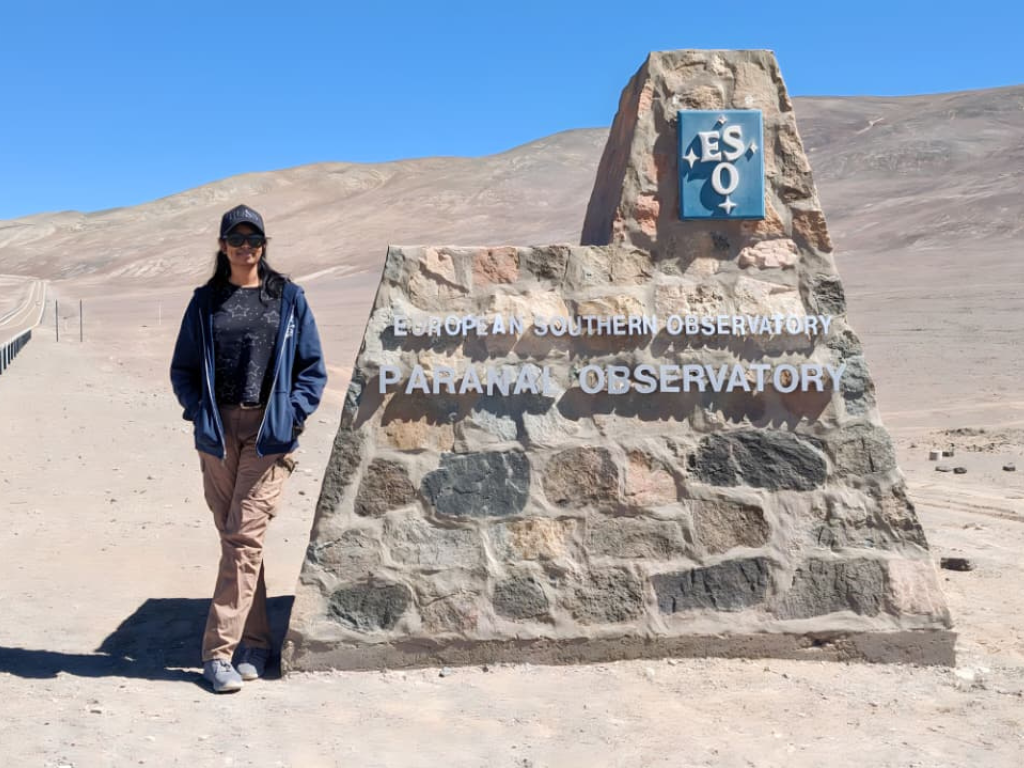
Raj at the Paranal Observatory run by the European Southern Observatory at Taltal, Antofagasta, Chile. Source: Anitha Raj
“There were little to no options for us in India to pursue an astronomy degree”
Despite how cool her work sounds now, Raj’s journey into astronomy wasn’t exactly a walk in the park.
She began her academic career as a BSc student in Physics at Dr. M.G.R. Educational and Research Institute in India. While she was interested in physics, her passion lay deeper — in the stars.
“I was interested in several fields — nuclear physics, quantum physics, astronomy,” she recalls. “So I started a science blog as a way to explore them.”
She named it StarDustWaves, and it became her personal lab notebook. Writing simplified explanations of complex scientific papers helped her understand the material and led her heart straight to astronomy.
But there was a problem: in India, there were very few options for pursuing an astronomy degree, especially at the postgraduate level.

Raj is an ANID Scholarship holder in Chile. Source: Anitha Raj
“Even if you want to specialise in astronomy, you need to sit for multiple entrance exams, and there’s no guarantee you’ll get a spot,” she explains.
So Raj pivoted, she pursued a Master’s in Physics at DG Vaishnav College in Chennai, keeping her ultimate goal in sight.
When it came time to apply for a PhD programme, Raj cast a wide net, submitting applications to universities in Australia, Germany, Poland, and Chile.
“I got shortlisted in Germany and Poland,” she says. “But I ended up getting an offer from Chile.”
Yes, Chile — halfway across the world, and in a country where she didn’t even speak the language.

As part of her PhD, Raj is pursuing her Studentship at the European Southern Observatory’s Garching headquarters to characterise the atmosphere of hot-Jupiters using transmission spectroscopy. Source: Anitha Raj
Now in her final year of her PhD in Astronomy and Planetary Science at the University of Atacama, Raj is preparing to defend her thesis, the culmination of years of research, relocation, and resilience.
From starting a science blog in India to pursuing an astronomy degree in Chile, Raj is proof that if you’re curious enough, the universe will eventually reward you with more questions to chase.
Whether it’s searching for alien life, studying “diamond rains,” or decoding techno signatures, Raj is part of a global team of researchers turning science fiction into something a little closer to a science fact.
Popular stories
10 American colleges that look like Hogwarts

Degrees that help you make up to RM42 million (US$10.5m): The education of Malaysia’s richest influencers

7 European countries where international students can live and job hunt

The education of ‘Professor’ Jiang, the world’s most-watched YouTube lecturer