




Executive MBAs are experiencing a renaissance among high achievers seeking transformative career acceleration. The 2025 EMBAC survey reveals EMBA graduates’ average salaries surged from US$192,644 at programme start to US$226,428 by completion — a compelling 17.5% increase while still enrolled.
But here’s what makes EMBAs different: it’s not just about the salary bump. Today’s professionals are investing in knowledge they can use immediately. With established networks and real decision-making power, EMBA students turn what they learn into action right away — creating value for their companies and their own careers at the same time.
The people you learn alongside matter just as much as what you learn. Your cohort includes C-suite executives, entrepreneurs, and industry leaders who bring diverse perspectives to every discussion. It’s less about networking and more about gaining access to a brain trust of experienced strategists tackling the same high-stakes challenges you are.
If you’re looking to level up without pausing your career, then consider the EMBA programmes at these leading business schools:

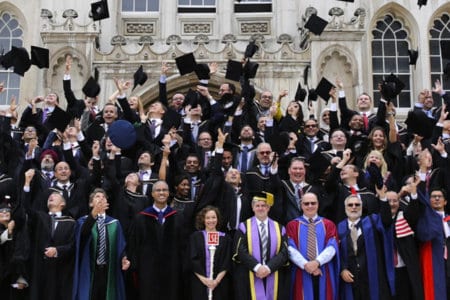
Haslam’s EMBA–Strategic Leadership (EMBA-SL) develops executives and entrepreneurs into adaptable, transformational leaders driving positive change. Source: Haslam College of Business
Haslam College of Business
Today’s leaders operate in environments defined by rapid change and increasing complexity. For those looking to rise to that challenge, the Executive MBA for Strategic Leadership (EMBA-SL) at the University of Tennessee, Knoxville’s Haslam College of Business offers applied learning that helps professionals worldwide strengthen their strategic capabilities and amplify their impact.
Ranked #10 among US public universities for EMBA programmes by the Financial Times, and #9 by Poets & Quants, the programme attracts accomplished leaders who want to sharpen their skills and broaden their perspectives.
Designed with executive schedules in mind, the one-year structure makes that growth achievable without stepping away from your career. Through four nine-day residences, you’ll minimise time away from the office while building meaningful relationships with faculty and classmates.
What sets UT’s Executive MBA apart is its applied curriculum, built around the practical needs of experienced leaders. Ranked #2 among US public universities for alumni satisfaction by the Financial Times in 2025, the programme places emphasis on learning that drives tangible results.
Nowhere is that emphasis more evident than in the Organisational Action Project. Rather than working through hypothetical scenarios, you’ll tackle a real business challenge within your organisation. Through this individualised project, you’ll design and implement a solution with guidance from a faculty advisor, driving measurable results before graduation.
Taken together, these experiences equip UT’s Executive MBA students with the strategic insight and practical expertise to lead transformational change with greater clarity, influence, and vision.
Learn more about UT’s Executive MBA for Strategic Leadership
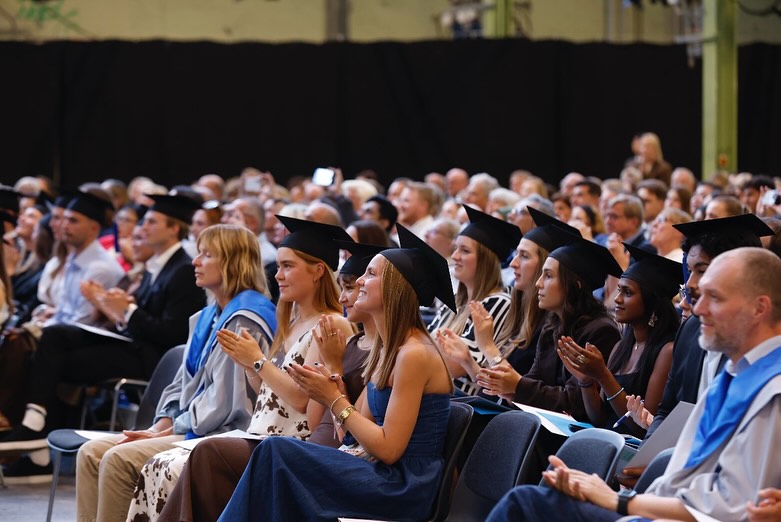
Copenhagen Business School’s EMBA equips you to navigate a turbulent global business environment and become a leader who drives sustainable impact and organisational success. Source: Copenhagen Business School/Facebook
Copenhagen Business School
Leadership development usually happens in sequence: learn, graduate, then apply. Copenhagen Business School‘s EMBA collapses that timeline entirely by turning your workplace into a laboratory. You’ll attend classes three to five days monthly across two years, spending around 75 days total in the classroom. Between sessions, you’re back at your desk implementing what you’ve learned, testing frameworks on actual problems with actual consequences.
That immediacy extends to how the curriculum unfolds. You’ll first gain deeper insight into your own organisation, understanding internal dynamics with new sophistication. From there, the focus shifts outward to growth drivers: market dynamics, customer behaviour, and competitive positioning. These threads then come together into a strategic vision that balances performance with sustainability. Along the way, you’ll select a concentration in Digitalisation, Entrepreneurship, Governance and Sustainability, or Finance, building expertise in domains critical to modern business.
This design ensures every element serves an immediate application. Core courses build the foundation. Concentrations sharpen specific capabilities. The Integrated Strategy Project ties it all together by tackling live business challenges as they arise, not as retrospective exercises.
The learning environment adds another layer. The Financial Times ranks the programme seventh globally for work experience, and it shows in the classroom. You’ll engage with participants spanning industries and functions, gaining perspectives that challenge conventional thinking. Meanwhile, faculty maintain active business partnerships alongside academic research, ensuring relevance without sacrificing rigour. Classes prioritise dialogue and case analysis over lectures.
The difference shows quickly. You won’t return to work ready to lead differently. You’ll already have been leading differently for two years.
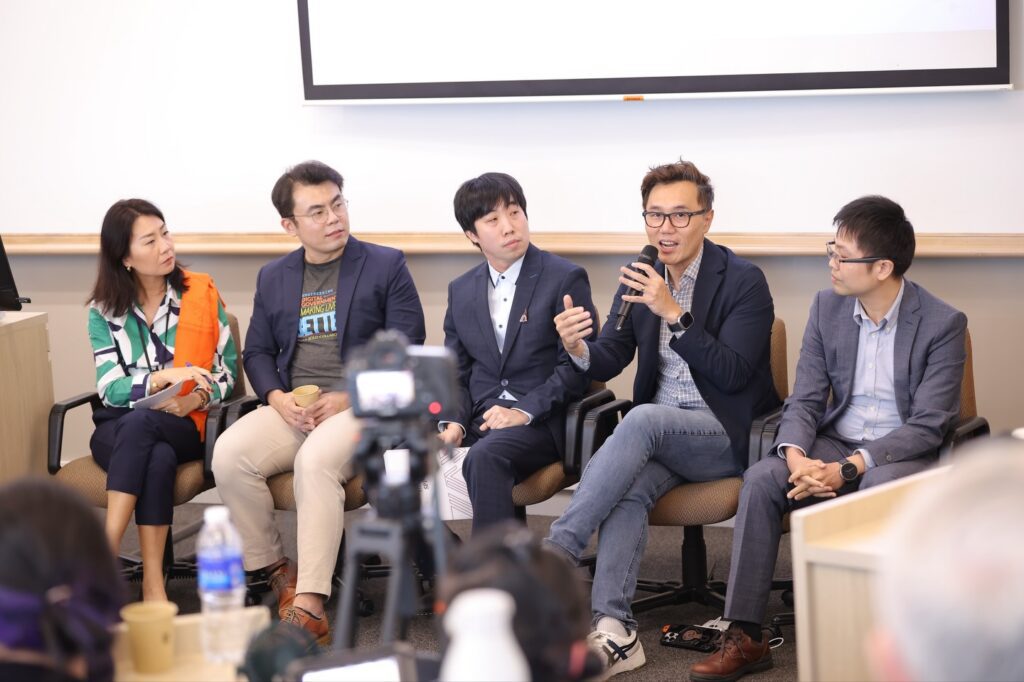
NUS Business School’s EMBA is ranked 1st in Asia-Pacific and 14th globally in the QS Executive MBA Rankings 2025. Source: NUS Business School
NUS Business School
The best leadership programmes redefine how you see the world and your place in it. The National University of Singapore (NUS) Business School’s EMBA delivers this kind of transformation through a design that balances global perspective with Asia-Pacific depth. Ranked consistently among the world’s top EMBA programmes, it draws on NUS’s reputation as a leading global university to offer you unparalleled regional exposure without requiring you to pause your career.
Your 15-month journey unfolds across six residential segments, each lasting one to two weeks. This structure creates natural rhythms for learning, allowing you to immerse yourself during intensive sessions while absorbing new frameworks and building connections. You then return to your organisation to put these ideas into practice, turning your workplace into a laboratory where theory meets reality.
Throughout the programme, you’ll work through 10 core courses and a minimum of six electives. Sessions occur every two to three months, typically for one week at a time, giving you the flexibility to maintain momentum in your role while advancing your education. You’ll experience all of this alongside about 80 senior leaders from more than 20 industries and nationalities, guided by 140 faculty members from internationally recognised universities who bring extensive consulting experience across Eastern and Western business contexts.
This diverse learning community becomes even richer through short exchanges with premier institutions like Berkeley Haas and IMD Switzerland. These one-week modules in business hubs across Asia, the US, and Europe deepen your understanding of different markets and business environments, broadening your strategic lens with each experience.
Popular stories
Beyond the boundary: These are India’s most educated cricket players

EXO Kai’s LACOSTE era is serving elite energy — like the study history of past, present EXO members

History and … Public Health? The surprising education of the cast of ‘Scream 7’

Elite and exclusive: Universities with the toughest admissions criteria