





It’s 2026, and more university students than ever are building social apps like Cluely, Ditto, Dayli, and Offline, among many others, while still studying. Some like Allen Wang, founder of Ditto, and Chungin (Roy) Lee, founder of Cluely, are so committed that they even drop out to focus on their startups full-time. Perhaps AI’s rapid growth has something to do with it, making it easier to experiment, launch ideas quickly, and connect with users in ways that weren’t possible before.
To get a clearer picture, we sat down with Arthur Park, the co-founder of Dayli, a relationship-first social platform connecting you with the people who matter in your life, to hear firsthand what drives students to launch social apps while juggling university life. And he believes there are mainly two reasons for this scenario.
“First, people are realising that the barrier to entry for becoming a startup founder is getting lower and lower,” he says.
“A big part of that is because of AI. AI has significantly eroded the technical moat that once existed. Before, one of the biggest risks in startup development was the technical side — even just building an MVP, the very first version of a product, could take two to three months. Now, it can often be done within a week. So you’re not sacrificing nearly as much time to get started.”
The second reason is cultural. Gen Z is moving away from the traditional corporate path and increasingly wants to create something of their own. Social media plays a role in this shift. On platforms like TikTok and Instagram Reels, students see influencers and peers succeed with startups and think, “I want to do that too.” That visibility and inspiration make starting a business feel not only possible but exciting.
“I believe that’s a big reason why so many young people are getting into startups,” Park says.

Park represents a Gen Z shift away from traditional corporate paths, driven by a desire to create something of his own, such as social apps. Source: Arthur Park
Does university still matter for young entrepreneurs
Do students still need university, or is it better to jump straight into entrepreneurship? For many young founders, university remains a critical starting point, even if completing a degree isn’t the goal.
Park, who is currently studying International Studies and Economics at The Johns Hopkins University, says the experience of attending university was invaluable for him.
“For me, I found all of my co-founders at university,” he says. “The best people I work with today, the ones who inspired me to get into startups and supported me when we were struggling, were my friends from school. We were the people sitting in the same dorm room until two or three in the morning, talking about our startup, discussing how we wanted to grow, and feeding off each other’s energy.”
That kind of energy, he explains, is hard to find outside of a university setting. While finishing a degree is a personal choice, attending university provides aspiring entrepreneurs with access to a unique community. Being surrounded by motivated, driven peers makes it easier to connect, exchange ideas, and collaborate. The environment nurtures creativity and momentum, which can be crucial when starting a business.
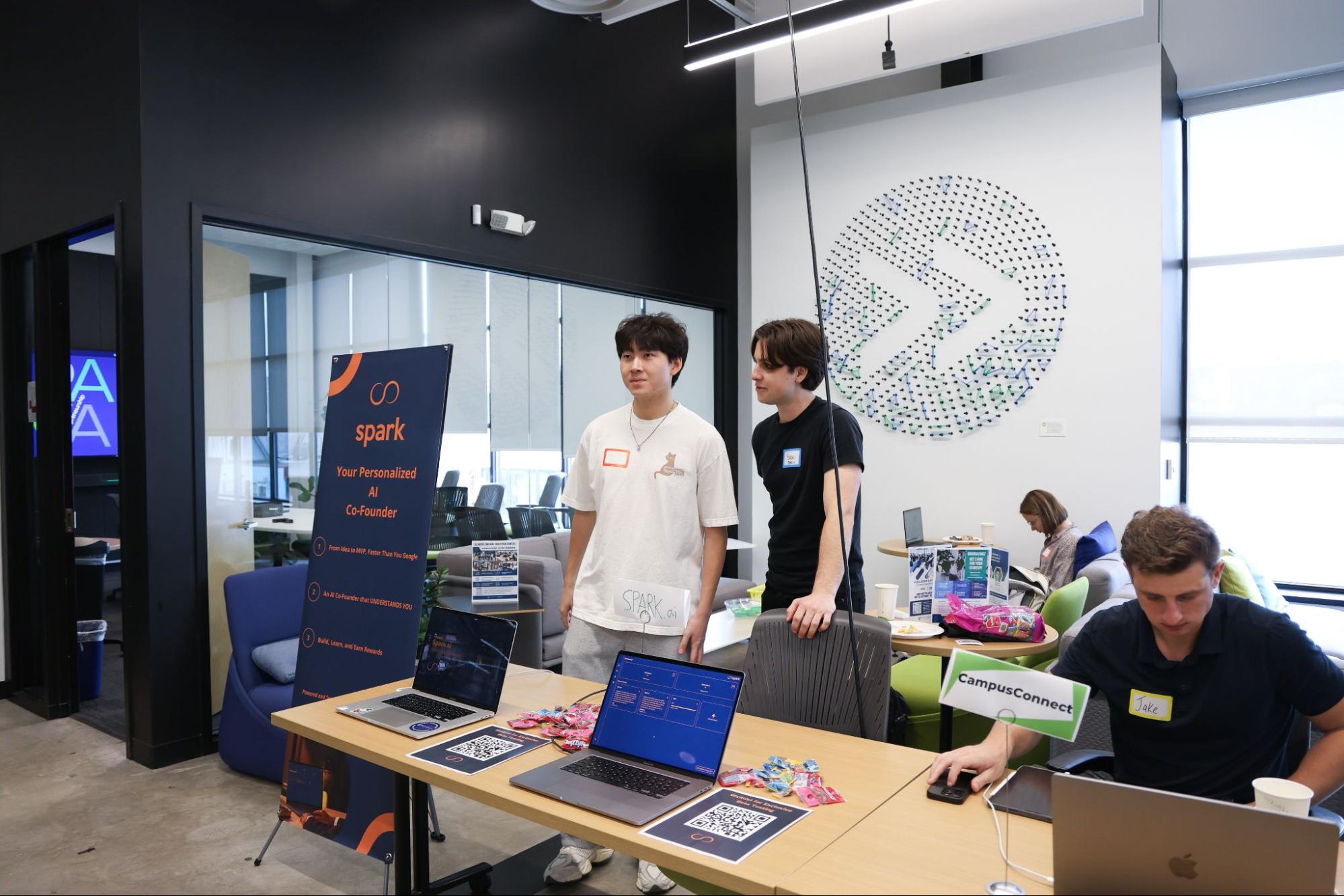
While Park doesn’t take a strong stance on whether to finish your degree or drop out, he believes attending university is definitely worth it. Source: Arthur Park
The power of taking the first step
Balancing the intensity of startup life with full-time studies at Johns Hopkins is something Park experiences on a daily basis.
During his sophomore year, he was involved in multiple ventures. Daily, the startup he focuses on now wasn’t the only project on his plate. Managing schoolwork alongside these projects meant making sacrifices.
“Back then, I really had to sacrifice a lot of the time I would have normally dedicated to classes,” he says. “If I could skip a class, I would. If I could study on my own and still manage to get decent grades, that’s what I did. I wasn’t aiming for straight A’s or A+’s; I was fine with getting B’s and being happy with that.”
His grades did dip a little, but Park sees that as part of the process. Trying to excel in two demanding areas simultaneously is nearly impossible. To him, success requires going all in on one focus.

Park has talented technical co-founders building Dayli, while he, without a tech background, learns coding on the side to stay involved in both front-end and back-end work. Source: Arthur Park
For students who want to start something meaningful but feel they aren’t ready, Park has a message. “I think the biggest lesson I’ve learned is that you can’t wait until you’re ready, because once you feel ready, it’s probably already too late,” he says.
“Take dropshipping, for instance, or the wave of people starting clothing brands. By the time those things start popping up all over social media, that’s when you know it’s already too late. The model has been proven; many people are already doing the same thing, and the space is already saturated. Entering at that point is much harder.”
He believes that startups are similar. The appeal comes from the unknown. Nobody can predict how big or impactful a new idea will become. If everyone already knew the answer, everyone would already be pursuing it. That uncertainty is part of the reason entrepreneurship exists.
The key, according to Park, is to trust yourself and take that first step, even if you don’t have complete certainty. Mistakes are inevitable, but failing quickly allows for faster learning.
Students who try without delay gain momentum, learning more in months than they could in years of hesitation. For Park, the process of starting, learning, and adjusting is as valuable as any finished product.
Popular stories
Why university students are suddenly obsessed with building social apps

Pack your bags, there’s good reason to move to the most expensive countries to live in

7 inspiring movies every student must watch

The ultimate international student guide to visa fees, from lowest to highest cost