



A truly meaningful education does not ask children to sacrifice creativity for academic strength. The best childhoods make room for both — curiosity that wanders and structure that steadies. It is in that balance that confidence takes root. For over five decades, the International French School in Singapore has built its reputation on that premise. The school has become a benchmark for structured, multilingual education in the region — rigorous without being rigid, ambitious without losing sight of the child.
Yet longevity alone is not enough in a city as fast-moving as Singapore. Expectations evolve. Families do too.
“Over recent years, we have seen a clear shift in demand from expatriate and internationally minded families in Singapore. Many are looking for an English-medium international education, but with stronger academic structure than what is sometimes perceived in purely play-based models,” says Sébastien Barnard, Director of Marketing Communications & Admissions and EIS Project Lead.
“The English International Stream (EIS) was created to respond to that demand while remaining true to what IFS does best: academic rigour, structure, and long-term educational continuity.”

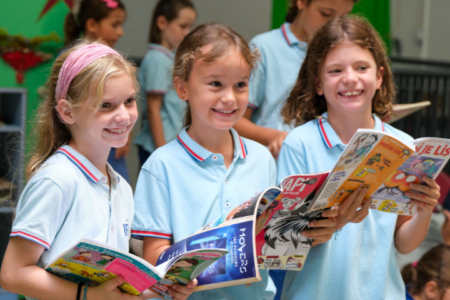
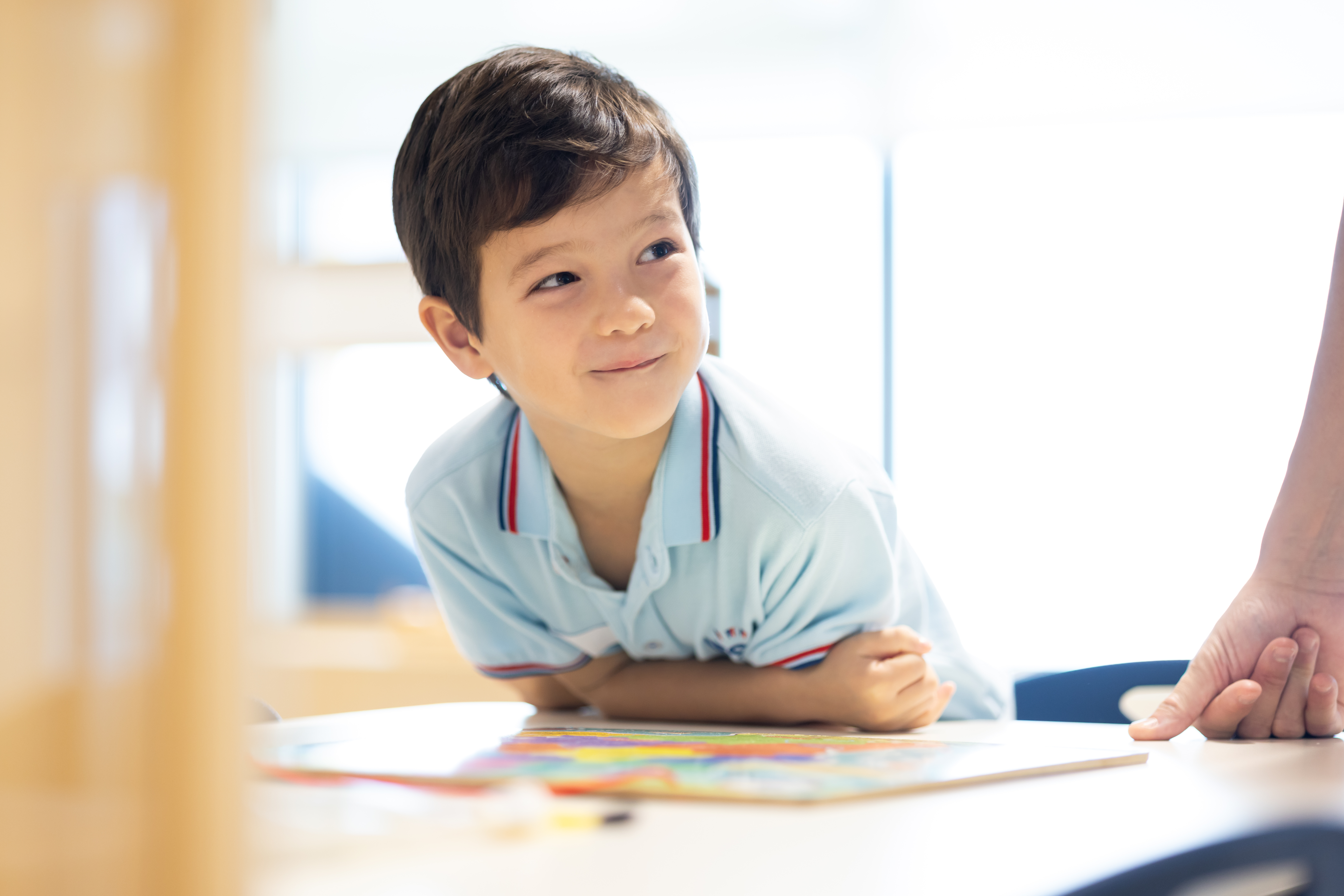
EIS teachers create a space for students to ask questions and learn through experience. Source: International French School (Singapore)
A structured foundation, with distinct French influence
The EIS, designed for Singaporean and expatriate families enrolling their children in kindergarten (École Maternelle, ages three to five) or Grade 1 (CP (Cours Préparatoire), age six), offers children the best of both worlds: an English-language education enriched with International French School Singapore’s signature “French Touch.”
“The French curriculum provides what we refer to as the ‘academic skeleton’ of the programme. It ensures a coherent progression in areas such as language development, early mathematics, logic, and cognitive structuring,” explains EIS Coordinator & Grade 1 Teacher Sarah King. “Importantly, in the French tradition, play is considered ‘serious learning’, which aligns very well with modern early-years research.”
Learning here is anything but one-dimensional. It’s shaped around five areas of the French model to support the whole child: language, logic, discovery, movement, and creativity. However, classrooms are not dominated by lectures. Students exchange ideas through conversation, play with sounds to develop reading skills, build motor skills through physical activity, experiment with drawing and painting, sing songs, explore digital tools, and learn from one another.
“The content framework remains rigorous, but the delivery is inquiry-driven,” says Barnard. “Children are encouraged to ask questions, explore themes, collaborate, and engage in problem-solving activities. Influences from international practices such as Reggio Emilia and Montessori ensure that learning remains active, meaningful, and child-centred, rather than passive or purely instructional.”
Language, too, is lived rather than memorised. Students choose French or Mandarin as a second language and encounter it through song, storytelling, cooking, and collaborative workshops. Vocabulary becomes something used in context — explored through experience rather than confined to a textbook.
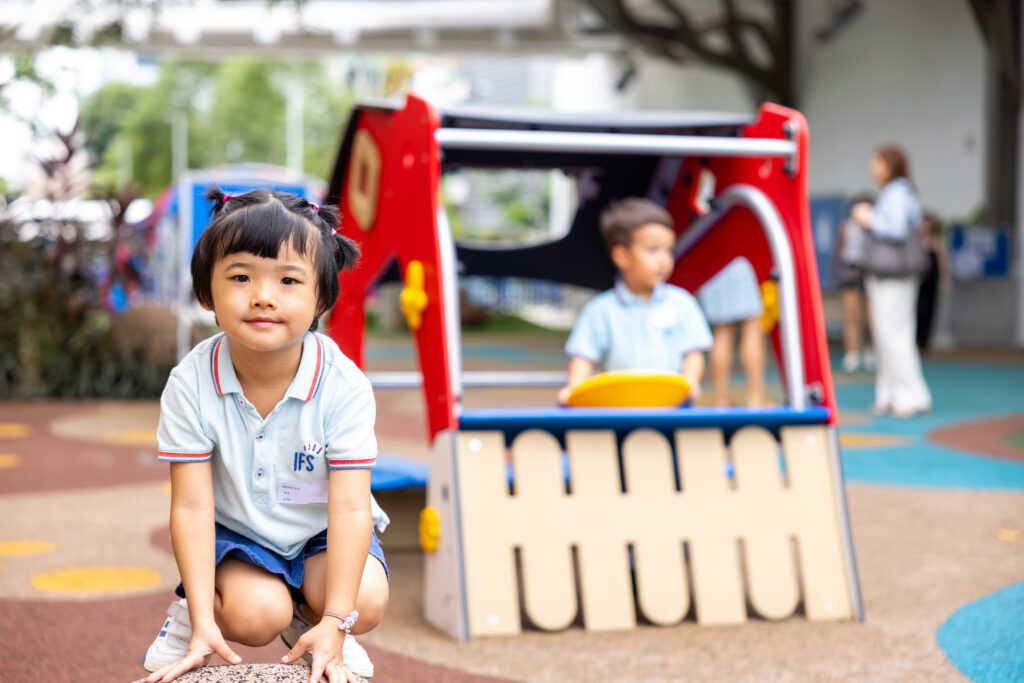
With projects, games, songs, and real-life contexts, children at IFS learn by doing. Source: International French School (Singapore)
A campus designed for possibility
The EIS setting itself signals intent. It’s housed in Singapore’s first zero-energy kindergarten, part of International French School Singapore’s $80 million campus expansion. Because of this, “children observe solar energy, resource management, and environmental responsibility as part of their daily experience,” shares King. “This naturally fosters environmental awareness and global citizenship from an early age.”
The school’s architecture was designed with learning in mind. The kindergarten follows a villa concept, where four spacious classrooms are connected by a shared Agora. Add in creative ateliers and a chef-led pedagogical kitchen, and you have a space that invites exploration at every turn.
“The chef-led pedagogical kitchen is a perfect example of action-based learning. Children develop language skills, cultural awareness, mathematics, and collaboration while cooking together,” adds King. “Learning becomes multisensory and meaningful, helping concepts stick because students experience them physically and socially.”
All of it feeds into a larger ambition: to build strong academic foundations without dimming curiosity. And the vision stretches well beyond the early years. “EIS is designed to grow with the child. While it launches in Kindergarten and Grade 1, the curriculum framework is being developed to extend into Primary and beyond, offering a seamless educational pathway within one school,” says Barnard.
“Our ambition is to provide students with a solid academic foundation and a passport to global universities, while preserving the values and excellence that define IFS.”
Follow the International French School in Singapore on Facebook, Instagram, X, LinkedIn, and YouTube