




Jeshua Choong always dreamed of creating something of his own. With an economics degree from the London School of Economics and Political Science (LSE) and years working in the corporate world, including Malaysia’s central bank, he had every reason to follow a secure career path.
But the routine never felt like enough. He wanted freedom, creativity, and the chance to build something meaningful.
After nearly eight years in finance, Choong joined his friends in their startups. “I spent the next three years working with friends in their startups and businesses, learning how to run a company,” he says.
It wasn’t always easy, but each challenge sharpened his skills and confidence.
By 2021, Choong felt ready to step out on his own. He launched carching, a mobility startup designed to help car make money from every drive. At the same time, it gave brands a smarter, more targeted way to engage with offline audiences.
Today, the service currently operates in Malaysia, the Philippines, and Thailand.

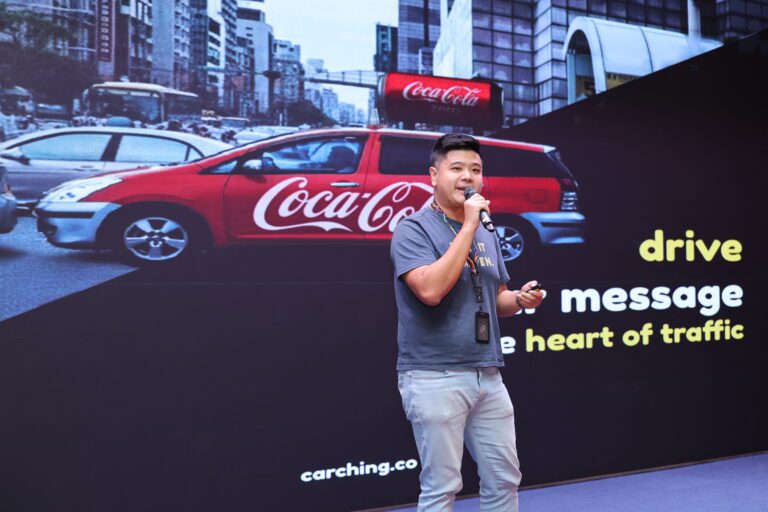
Carching can reach locations that billboards cannot. While billboards cannot be placed directly outside the outlets of competitors, branded vehicles can. Source: Jeshua Choong
Learning to think like an entrepreneur
Growing up, Choong’s father owned and operated a small real estate business. Being around someone self-employed gave Choong confidence and space to explore his own ideas. Even in primary school, he noticed opportunities others overlooked.
“In Year One — this was in the 90s — we had erasers with different country flags, and we used to play a game trying to win other people’s erasers,” he says. “I started buying lots of erasers and selling them in school.”
Around the same time, he charged classmates for drawings of the Titanic, using school book pages, and got involved in selling tickets for school fundraisers. Those early experiences showed him that he could create value and take initiative. “I think that environment, combined with the few opportunities I grabbed, really nudged me in this entrepreneurial direction,” he says.
When Choong went on to study economics at LSE, his mindset developed further. The London university challenged him with questions and problems that pushed him to think differently.
“Being at LSE, of course, everyone is highly driven,” he says. “Even before the first year, during gatherings with alumni, I saw classmates who had already secured their internships for the year. The competitiveness there naturally creeps into you, and you start becoming competitive as well.”
While LSE focused on preparing students for careers in investment banking and private equity, Choong found there were other benefits. Looking back, he can see that his degree shaped his ability to assess opportunities, take risks, and solve challenges strategically.

Choong advises pursuing genuine passion, as it fuels perseverance, adaptability, and the resilience needed to keep moving forward until success. Source: Jeshua Choong
Choosing problems worth solving
Choong believes that problems are everywhere, but not every problem is worth building a business around. Some issues may offer little or no immediate monetary value, meaning you pursue them for other types of impact or long-term benefits. For example, developing a tool to help local teachers track student engagement might not generate huge profits at first, but it could transform education outcomes over time.
Other opportunities, however, provide more immediate financial returns. For instance, launching a subscription-based meal delivery service or a mobile app that automates everyday business tasks can quickly generate revenue and scale with the right market.
Both paths are valid. The choice depends on what you’d like to prioritise. Do you want to focus on making money or run a project you truly care about?
“Everyone will tell you that any problem worth solving is worth pursuing,” he says. “But the real question is: do you want to endure the pain and effort required to solve it? Is the problem painful enough for you? And is it painful enough for the group of people you want to dedicate your life to helping?”
Over his four-year startup journey, Choong learned the importance of knowing your total addressable market. Understanding the potential size of a market helps determine funding potential, investor interest, and the growth trajectory.
But he also emphasises passion. “Many founders burn out after three to four years because they treat their startup purely as a business model — they realise they aren’t passionate and are just trying to make money,” he says. “That mindset rarely sustains a long-term venture.”

Unlike Grab cars, carching drivers follow consistent routes, enabling targeted area coverage and optimised impressions. Source: Jeshua Choong
One step at a time toward your startup
Choong believes that not everyone is meant to be an entrepreneur. “Telling everyone to ‘follow your dreams and start a business’ is very risky advice,” he says. “Imagine a world where 100% of us are entrepreneurs — who would do the essential work that keeps society running? Taking risks with low payoff can have serious consequences.”
Instead, he advises focusing on something that genuinely excites you. It could be solving a problem, exploring a topic, or pursuing a personal passion. “Passion is crucial because perseverance and tenacity are what allow you to stick with a dream,” he says. “The most successful entrepreneurs are the ones who keep persevering, pivoting when necessary, and pushing forward until they reach the finish line.”
Risk is another key factor. If you’re just starting, think about how comfortable you are with uncertainty. If you’re risk-averse but still passionate about your idea, Choong suggests finding a partner who can handle the risk. If you’re more comfortable taking chances, you may already be ready to step away from a traditional job and focus on your startup.
For Choong, the first step was simply switching off the fear and taking action. He approached entrepreneurship like a checklist, tackling one step at a time. “Taking the first step makes the second step easier, and gradually, everything becomes more manageable,’ he says. “You don’t have to jump in all at once; test the waters slowly, step by step, and you’ll realise it’s okay to move forward.”