

From the power grids lighting up our cities to the microchips powering our handheld gadgets, electrical engineers are at the forefront of innovation. And with emerging technologies like artificial intelligence (AI) and machine learning on the rise, their work is pivotal in advancing the industry.
This discipline offers a challenging yet rewarding career path for those fascinated by how electricity shapes our world and eager to contribute to the next generation of technological advancements. With about 19,000 openings for electrical and electronics engineers projected each year, now is the time to be part of this demanding yet dynamic field.
Get the best start for your future with a master’s degree from one of the leading universities below:

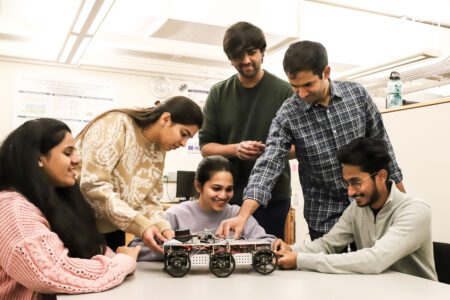
Graduates of the Electrical Engineering department are well-prepared for high-impact careers. Source: University of South Florida Electrical Engineering/Facebook
University of South Florida
The University of South Florida is where groundbreaking innovation, research excellence, and real-world impact come together to transform students into future leaders of their chosen fields. The Electrical Engineering department, in particular, offers a dynamic, forward-looking education to graduate students hailing from over 140 countries.
Here, you will have direct access to world-class laboratories, collaborative research centres, and mentorship from faculty who are actively shaping the future of the field. These are internationally recognised scholars and researchers, who can and will guide you to work on projects funded by federal agencies such as NSF, NIH, DOE, ONR, DARPA, USDA, ARL, Cyber Florida, and NASA, and private industry.
From the MS in Electrical Engineering to the PhD in Electrical Engineering, these graduate programmes cover a broad range of specialisations, including Artificial Intelligence and Machine Learning, Bioelectrical Systems, Communications, Controls and Automation, Cybersecurity, Power and Energy, Robotics, Semiconductor and Nanoelectronics, Quantum Communications, and Wireless and Microwave Systems. Each allows you to align your degree to today’s emerging technologies and evolving industry demands.
It’s an effective approach — just look at graduates who are currently working at top companies such as Intel, Texas Instruments, Microchip Technology, Blue Origin, Lockheed Martin, Honeywell, L3Harris, Jabil, Raytheon, Qorvo, General Electric, ABB, EATON, SpaceX, and Amazon Web Services.
The university’s strategic location in Tampa, Florida is another key advantage. A vibrant and growing tech hub, with proximity to leading companies, this city is a great base to engage with the industry and give yourself the best start to your future career. Whether your goal is to become an industry leader, change the world through research, or advance in academia, the department provides the resources, flexibility, and inspiration to power your future. Apply to the University of South Florida today.

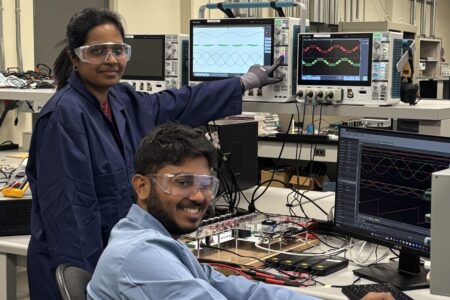
The Department of Electrical Engineering and Computer Science has more than 20 research groups, all working on different focus areas within electrical engineering. Source: The Henry Samueli School of Engineering at UC Irvine/Facebook
University of California, Irvine
The University of California, Irvine aims to enhance people’s lives through rigorous academics, cutting-edge research, and dedicated public service. Its Department of Electrical Engineering and Computer Science has two further goals: to provide the finest education to produce more future leaders and to develop cutting-edge technology to meet current industry needs. These are achieved with the help of an globally renowned faculty who are all industry experts, providing you with the proper guidance and tools to navigate the challenging field.
You will also have the opportunity to conduct research at four world-class centres. Focus areas are diverse, spanning analogue, radio-frequency, and millimetre-wave integrated circuits and systems; antenna and propagation, bioelectronics, biotechnologies, flexible and wearable devices; control systems and robotics, communications and signal processing, information theory, machine learning, optical devices and circuits, microscopy, nano optics; power electronics, and semiconductor devices.
If you’re pursuing an MS in Electrical Engineering, you can choose from two plans: a thesis option and a comprehensive examination option. Whichever you choose, you will be required to develop a complete programme of study with advice from the department and the approval of your graduate advisor.
Both options combine theory and practical application. “Every day, I have the chance to learn new things about new subjects,” student Mustafa Bayer says. “We also learned how to apply and experiment with this knowledge and see the end results in real life at the lab environment.”
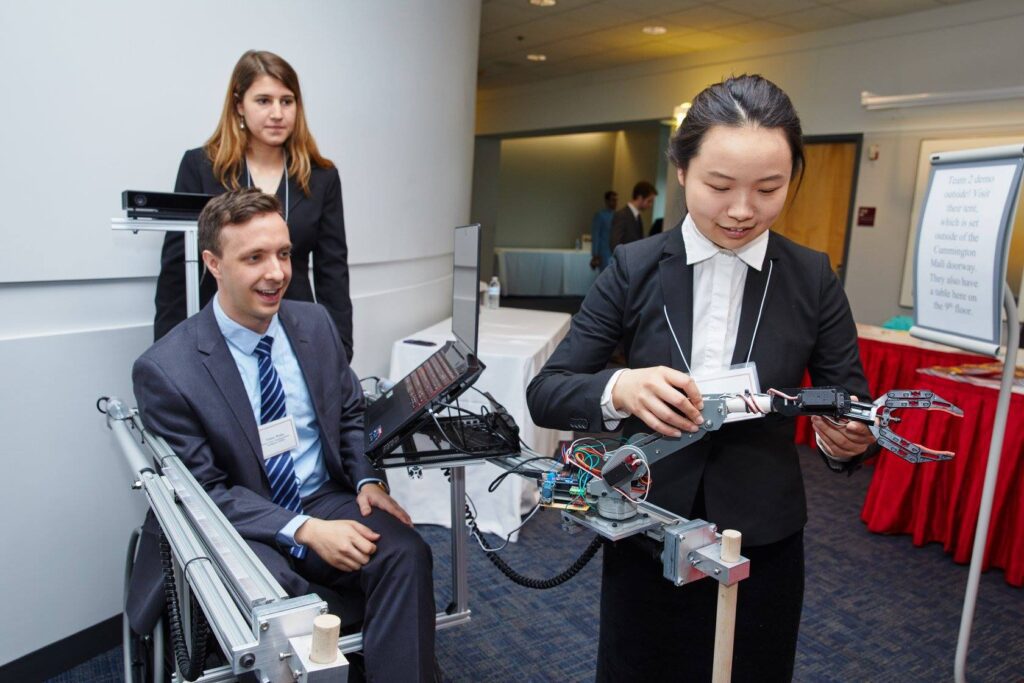
Boston University is home to more than 37,000 students from 140 countries. Source: Boston University Department of Electrical & Computer Engineering/Facebook
Boston University
Boston University is home to 17 schools and colleges, one of which is the College of Engineering, where the Electrical and Computer Engineering department is located. Here, students train to become “bold technology innovators; the designers of our interconnected future, hard at work in the present.” They have the support of internationally recognised experts and a location right in the heart of a global technology hub.
These are powerful advantages should you choose to join its Master of Science in Electrical & Computer Engineering. This programme stands out for combining two historically established fields: electrical engineering and computer engineering. Curriculum covers newly emerging subfields — such as data science, computational imaging, virtual reality, smart cities and environments, and the Internet-of-Things — that require skills from both EE and CE for success.
The MS further stands out for how flexible it is. You get to shape your Master of Science program and how you present yourself to potential employers. The programme comes with the option of obtaining your degree with engineering practice and/or with any of the interdisciplinary MS specialisations (Cybersecurity, Robotics, Data Analytics).
If you want to continue your studies to the next stage, the PhD in Electrical Engineering is the obvious choice. This research-led programme presents you with opportunities to conduct your own original experiments where collaborations are highly encouraged, not just in the university but outside of campus grounds too. Research topics cover Photonics, Electronics and Nanotechnology; Imaging and Optical Science; Data Science and Intelligent Systems; and Bio-Electrical/Computer Engineering and Digital Health.

The Electrical and Computer Engineering programmes at Carleton University are the largest in Canada. Source: Carleton University (Official)/Facebook
Carleton University
Graduates from Carleton University are prepared to enter the job market and change the world. They owe this to their Electrical and Computer Engineering programmes, the largest in Canada. Its list of graduate programmes is offered jointly with the University of Ottawa to form the Ottawa-Carleton Institute for Electrical and Computer Engineering. This unique collaboration means you’ll have access to resources and expertise from both universities.
Choose the MASc in Electrical and Computer Engineering if you seek a more researh-focused graduate degree with these specialisations and concentrations: Data Science, Climate Change, Software Engineering, and Modelling and Simulation. You are required to complete a research thesis that is original and your own. This degree
If you want your coursework to be more project-based, the MEng in Electrical and Computer Engineering is ideal. The specialisations and concentrations are similar to the previous master’s degree, only this requires you to work on existing and new projects that suit your interest and career path.
If you’d like to prepare for a career in academia, the PhD in Electrical and Computer Engineering is a top choice. It includes research projects ranging from high-speed/frequency circuitry to optical fibre communications to computer systems. There is also a Software Engineering concentration where you develop advanced skills and competencies in cutting-edge research areas such as AI, cloud computing, autonomous systems, cybersecurity, and more.
*Some of the institutions featured in this article are commercial partners of Study International




You might like