


At Johns Hopkins University, students don’t just imagine the technologies of tomorrow — they help create them. Undergraduate and graduate students, as well as postdocs, work side by side with some of the world’s foremost experts, tackling projects that promise to improve lives.
Two recent advances exemplify what’s possible: students helping teach a robot how to perform surgery independently and designing a prosthetic hand that can grasp and sense.
Teaching a robot to think like a surgeon
At Hopkins, student researchers were part of the Smart Tissue Autonomous Robot project team that made international news this summer by teaching a robot to perform a realistic surgery independently.
The new Hierarchical Surgical Robot Transformer, or SRT-H, trained on videos of surgeries performed by Hopkins surgeons, learned to perform a lengthy phase of a gallbladder removal, responding to and learning from voice commands from human team members—much like a novice surgeon working with a mentor.
Built with the same machine learning architecture that powers ChatGPT, SRT-H doesn’t just follow a script. It adapts to individual anatomical features, makes decisions on the fly, and self-corrects when things don’t go as expected.
The team, which included PhD student Juo-Tung Chen and undergraduate Antony Goldenberg, visiting graduate student Pascal Hansen, PhD student Samuel Schmidgall, and former postdoctoral fellow Ji Woong “Brian” Kim, trained the system to adapt in real time to unexpected changes, such as when the researchers changed the robot’s starting position and when they added blood-like dyes that changed the appearance of the gallbladder and surrounding tissues.
It responded to spoken commands — “grab the gallbladder head” — and adjusted when corrected.
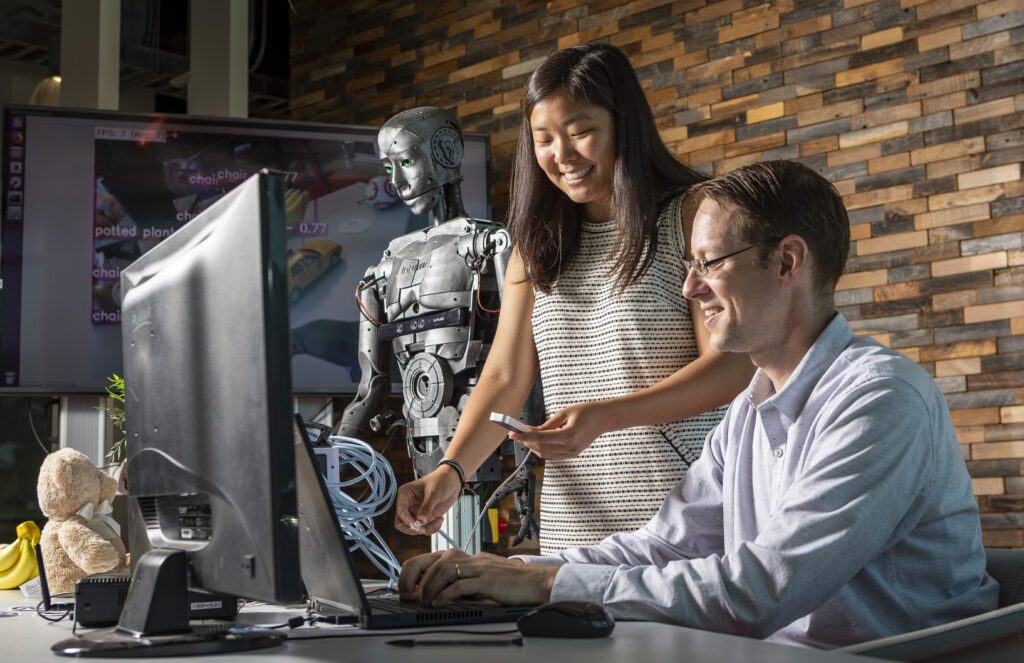
Johns Hopkins students trained a robot with AI to perform a complex gallbladder surgery independently. Source: Johns Hopkins University
“Our work shows that AI models can be made reliable enough for surgical autonomy — something that once felt far-off but is now demonstrably viable,” said Kim, who led much of the robot training while at Johns Hopkins.
Earlier versions of the robot performed three foundational surgical tasks — manipulating a needle, lifting tissue, suturing — but the gallbladder removal was far more complex. The robot now had to perform 17 tasks that included identifying ducts and arteries, grabbing them precisely, strategically placing clips, and cutting parts with scissors.
SRT-H learned by watching videos of Hopkins surgeons operating on pig cadavers, reinforced with captions describing each step. After training, it performed with 100% accuracy.
The team’s work appeared in Science Robotics.
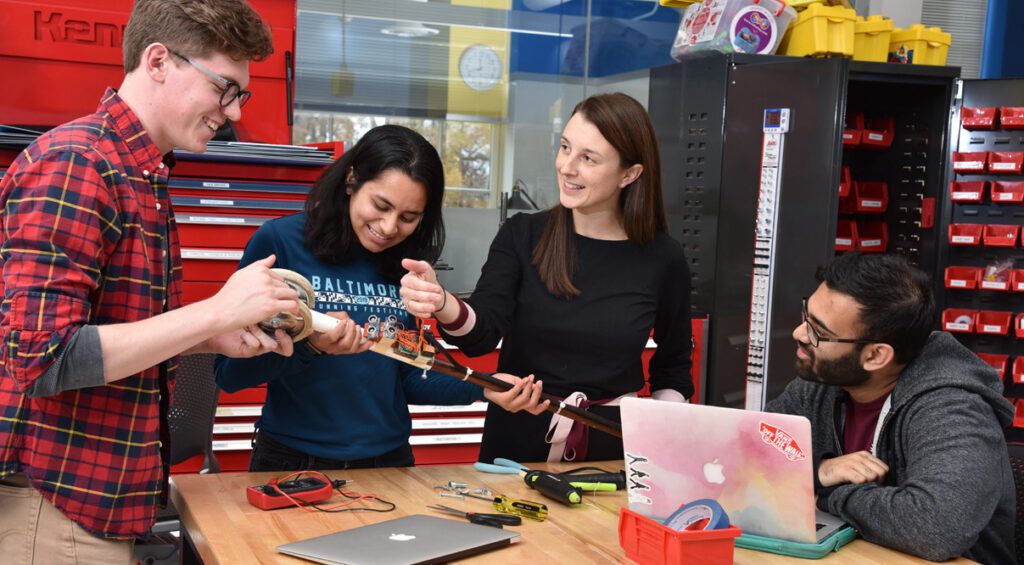
Behind every major breakthrough at Johns Hopkins is a team of students pushing boundaries in the lab. Source: Johns Hopkins University
A prosthetic hand that adjusts its grip
In another Johns Hopkins lab, biomedical engineering PhD student Sriramana Sankar set out to create a prosthetic hand that could do what others couldn’t: function like a natural human limb.
Working with a team that included Nitish Thakor, professor of biomedical engineering at Johns Hopkins, as well as collaborators at Florida Atlantic University and the University of Illinois, Chicago, Sankar developed a novel hybrid hand that features a multifinger system with rubberlike polymers and a rigid 3D-printed skeleton. Its three layers of tactile sensors, inspired by the layers of human skin, allow the hand to grasp and distinguish objects of various shapes and surface textures, rather than just detect touch. Each of its soft air-filled finger joints can be controlled with the forearm’s muscles, and machine learning algorithms focus the signals from the artificial touch receptors to create a realistic sense of touch.
“The goal from the beginning has been to create a prosthetic hand that we model based on the human hand’s physical and sensing capabilities — a more natural prosthetic that functions and feels like a lost limb,” Sankar said. “We want to give people with upper-limb loss the ability to safely and freely interact with their environment, to feel and hold their loved ones without concern of hurting them.”
In lab tests, the hand identified and manipulated 15 everyday objects — from pineapples and stuffed animals to dish sponges — with 99.69% accuracy. One standout moment came when it used only three fingers to pick up a thin plastic cup filled with water, without denting it.
The design draws from both rigid and soft robotics, a combination that mimics how human bones, joints, and tissue work together.
“The human hand isn’t completely rigid or purely soft — it’s a hybrid system,” Sankar said. “That’s what we want our prosthetic hand to achieve.”
The project, published in Science Advances and funded by the Department of Defense and the National Science Foundation, not only offers hope for people with limb loss but also points toward a future where robotic hands handle delicate materials with confidence.
A prosthetic hand that adjusts its grip
In another Johns Hopkins lab, biomedical engineering PhD student Sriramana Sankar set out to create a prosthetic hand that could do what others couldn’t: function like a natural human limb.
Working with a team that included Nitish Thakor, professor of biomedical engineering at Johns Hopkins, as well as collaborators at Florida Atlantic University and the University of Illinois, Chicago, Sankar developed a novel hybrid hand that features a multifinger system with rubberlike polymers and a rigid 3D-printed skeleton. Its three layers of tactile sensors, inspired by the layers of human skin, allow the hand to grasp and distinguish objects of various shapes and surface textures, rather than just detect touch. Each of its soft air-filled finger joints can be controlled with the forearm’s muscles, and machine learning algorithms focus the signals from the artificial touch receptors to create a realistic sense of touch.
“The goal from the beginning has been to create a prosthetic hand that we model based on the human hand’s physical and sensing capabilities — a more natural prosthetic that functions and feels like a lost limb,” Sankar said. “We want to give people with upper-limb loss the ability to safely and freely interact with their environment, to feel and hold their loved ones without concern of hurting them.”
In lab tests, the hand identified and manipulated 15 everyday objects — from pineapples and stuffed animals to dish sponges — with 99.69% accuracy. One standout moment came when it used only three fingers to pick up a thin plastic cup filled with water, without denting it.
The design draws from both rigid and soft robotics, a combination that mimics how human bones, joints, and tissue work together.
“The human hand isn’t completely rigid or purely soft — it’s a hybrid system,” Sankar said. “That’s what we want our prosthetic hand to achieve.”
The project, published in Science Advances and funded by the Department of Defense and the National Science Foundation, not only offers hope for people with limb loss but also points toward a future where robotic hands handle delicate materials with confidence.
Inventing the future, one project at a time
Working on everything from autonomous robots to prosthetic design, Johns Hopkins students are gaining real-world experience while developing solutions that can change lives.
Find an opportunity of your own by choosing from Hopkins’ more than 50 academic programmes.
Follow Johns Hopkins University on X, Facebook, LinkedIn, YouTube, and Instagram.