


The world is awash in data — streams of numbers, clicks, posts, transactions, and interactions flowing faster than ever before. But data on its own is blunt — it counts clicks and cases, but not meaning. It doesn’t ask why people behave the way they do, or how policy can shift outcomes for communities. For that, you need experts who understand both the science of society and the science of computation.
These are the kinds of professionals the University of California (UC), Berkeley’s Master of Computational Social Science (MaCSS) was designed to train. Launched with a US$5 million gift from alumnus and Guitar Hero founder Charles Huang, it was built on the belief that truly understanding the world takes the ability to see the people behind the numbers.
This one-year, in-person degree is especially beneficial for those with social science backgrounds who want to future-proof their knowledge. The curriculum goes beyond basic statistical analysis, integrating computing tools and techniques, advanced statistical approaches, and social science theories and findings. This combination prepares graduates to answer big questions about human behavior, social structures, and various other forces shaping our complex world.
Every element of the program is geared toward application. Students begin with a summer semester sharpening their computing and statistical foundations. From there, they move into intensive, interdisciplinary coursework to apply and expand their newfound skills. Whether it’s building models to understand housing inequality or analyzing networks of misinformation, the work is always tied to urgent, real-world problems.
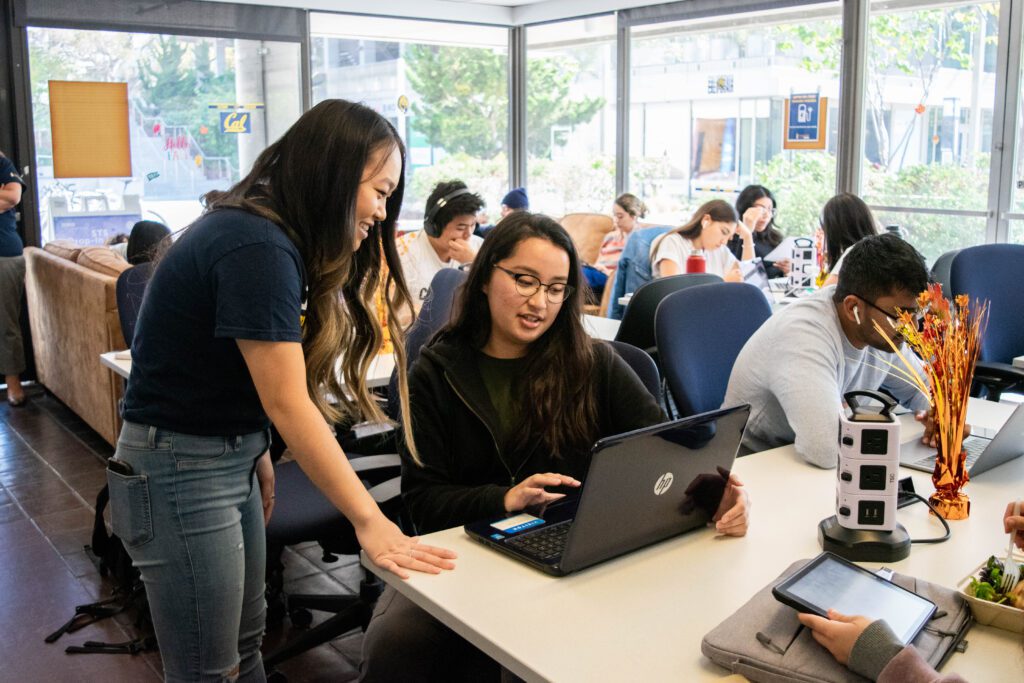
The MaCSS curriculum integrates three components: computing tools and techniques, statistical approaches to data analysis, and social-science theories and findings. Source: UC Berkeley
For 2025 graduate Eloise Wenxi Qin, the program’s biggest lesson was far from technical. “This program didn’t just teach us how to analyze data — it taught us how to sit with complexity, how to ask better questions, and how to back up our ideas with both evidence and empathy,” she says.
There’s never been a better time to gain such a skillset. Jobs that require data analysis and interpretation skills are growing fast, thanks to advances in computing and an explosion of information across sectors. In fact, the US Bureau of Labor Statistics predicts the employment of data scientists is projected to grow by 36% between 2023 and 2033.
UC Berkeley has already made strides in filling this gap. MaCSS recently celebrated the graduation of its inaugural class — a group that illustrates the program’s mission: using data to understand people, communities, and the systems that shape their lives.
Coming from California State University, Sacramento, Nayeli De Anda combined her undergraduate training in sociology and mathematics with computational methods to make data more ethical, inclusive, and impactful. At Berkeley’s Institute of Transportation Studies, she studied mobility patterns in Latin America to improve urban accessibility. Beyond the classroom, she engaged with industry partners like Dolby Laboratories, gaining a deeper appreciation for how technology shapes the way people connect and experience the world.
Sangmin Lee’s MaCSS journey was equally experiential. She came from Seoul National University, determined to use data science to fuel innovation in the tech and e-commerce space. While interning at FocusKPI, she built an AI-powered analytics pipeline using Python and GPT-4 to classify over 100,000 music app reviews, revealing hidden customer pain points and shaping product strategy. Her capstone at the Berkeley Police Department was just as impactful: she analyzed more than 60,000 service calls, designed a patrol zone optimization tool that improved workload equity by 20%, and saw her solution adopted by the department’s Strategic Planning Division.
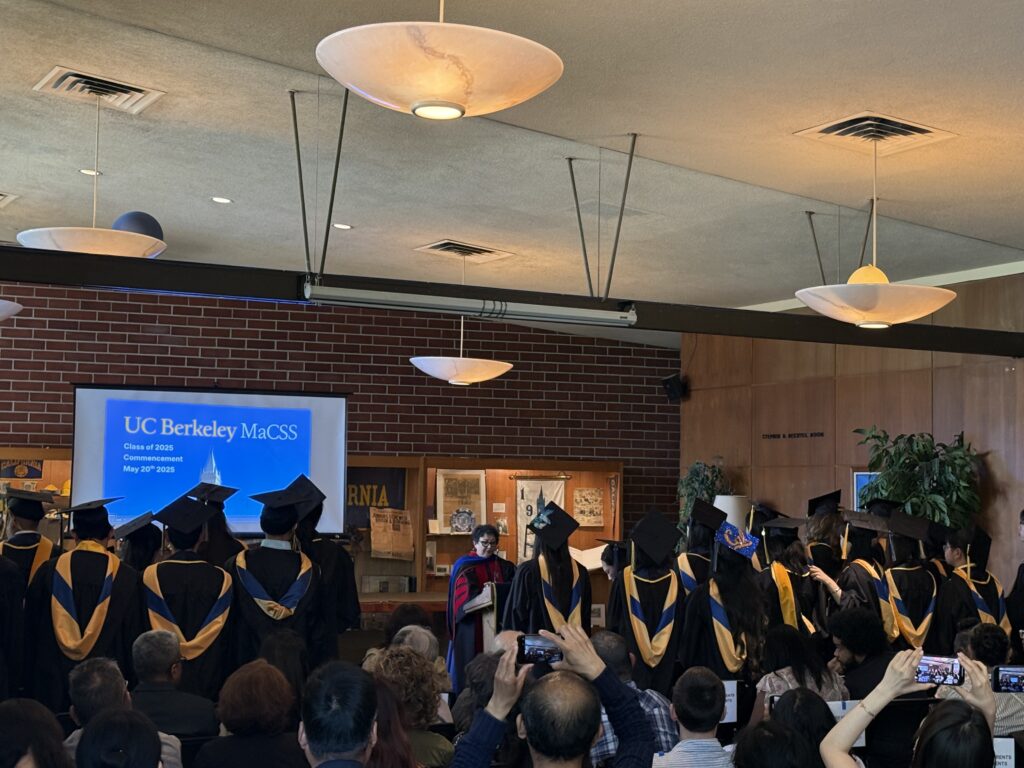
Dean Raka Ray addressing the inaugural MaCSS graduating class. Source: UC Berkeley
“The MaCSS program’s emphasis on practical application, paired with its sophisticated interdisciplinary curriculum, perfectly aligns with my professional goal of becoming a data analyst who can answer a wide range of social questions with innovative computational approaches,” says Lee, who continues her data journey today as a research analyst at Oakland Unified School District.
For David Camper, a poet, musician, and community organizer, the MaCSS program was a perfect opportunity to merge storytelling with analytics. That’s exactly what he engaged in at the Eviction Research Network, where he analyzed disparities in Oregon’s eviction data to highlight vulnerable populations. His long-term goal is to create a nonprofit that combines data analysis, community outreach, and the performing arts — ensuring that data is always context-rich and people-centered.
Social Sciences Dean Raka Ray sums up the first graduating class well: “Berkeley students certainly want to do well, but they also want to do good.” That ethos defines MaCSS — preparing graduates for careers as analysts in business, government, and nonprofits where the stakes are less numerical and more human.
Follow UC Berkeley MaCSS Program on MaCSS LinkedIn and Instagram pages.